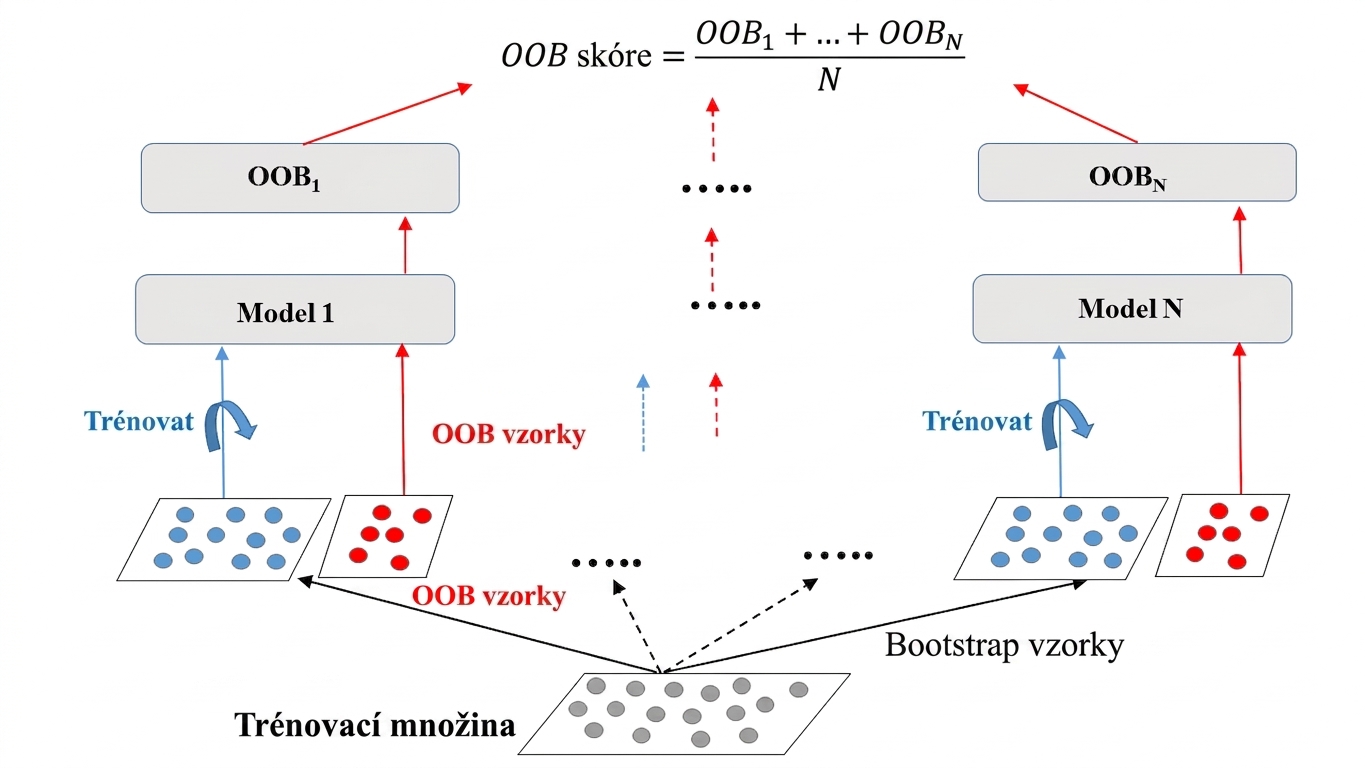
některé instance mohou být pro jeden model vzorkovány vícekrát,
jiné instance nemusí být vzorkovány vůbec.
Out Of Bag (OOB) instance
V průměru je pro každý model vzorkováno 63 % trénovacích instancí.
Zbývajících 37 % tvoří OOB instance.
OOB vyhodnocení
OOB vyhodnocení v sklearn (dataset Breast Cancer)
# Import models and split utility function
from sklearn.ensemble import BaggingClassifier
from sklearn.tree import DecisionTreeClassifier
from sklearn.metrics import accuracy_score
from sklearn.model_selection import train_test_split

# Set seed for reproducibility
SEED = 1

# Split data into 70% train and 30% test
X_train, X_test, y_train, y_test =  train_test_split(X, y, test_size= 0.3,
                                                     stratify= y,
                                                     random_state=SEED)
# Instantiate a classification-tree 'dt'
dt = DecisionTreeClassifier(max_depth=4,
                            min_samples_leaf=0.16,
                            random_state=SEED)

# Instantiate a BaggingClassifier 'bc'; set oob_score = True
bc = BaggingClassifier(base_estimator=dt, n_estimators=300,
                       oob_score=True, n_jobs=-1)


# Fit 'bc' to the training set
bc.fit(X_train, y_train)

# Predict the test set labels
y_pred = bc.predict(X_test)
# Evaluate test set accuracy
test_accuracy = accuracy_score(y_test, y_pred)

# Extract the OOB accuracy from 'bc'
oob_accuracy = bc.oob_score_

# Print test set accuracy
print('Test set accuracy: {:.3f}'.format(test_accuracy))