Ensemble Learning
Machine Learning with Tree-Based Models in Python

Elie Kawerk
Data Scientist
Výhody CART
Snadno pochopitelné.
Snadno interpretovatelné.
Jednoduché na použití.
Flexibilita: schopnost popsat nelineární závislosti.
Předzpracování: není třeba standardizovat ani normalizovat příznaky, ...
Omezení CART
Klasifikace: produkuje pouze ortogonální rozhodovací hranice.
Citlivost na malé změny v trénovací sadě.
Vysoký rozptyl: neomezené CART mohou přetrénovat trénovací sadu.
Řešení: ensemble learning.
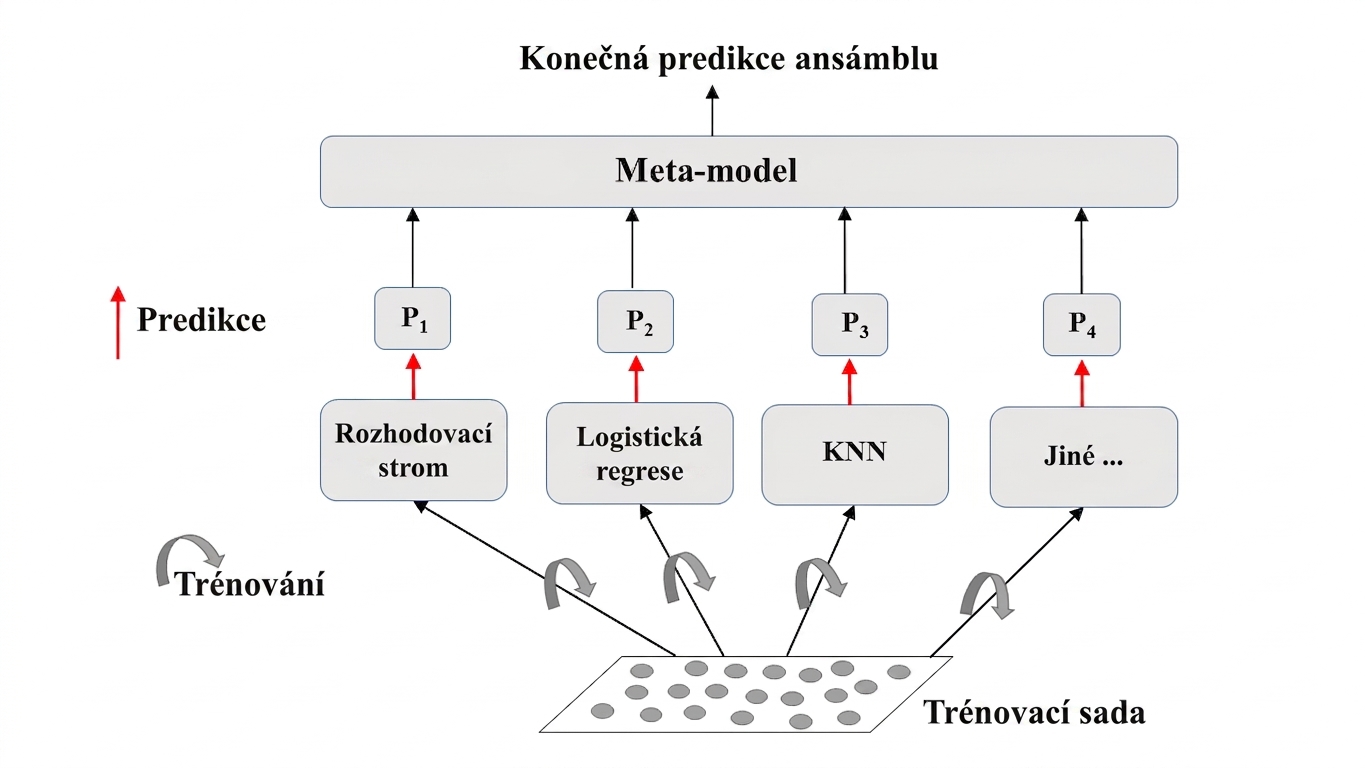
Ensemble Learning
Trénujte různé modely na stejném datasetu.
Každý model vytvoří své předpovědi.
Meta-model: agreguje předpovědi jednotlivých modelů.
Výsledná předpověď: robustnější a méně náchylná k chybám.
Nejlepší výsledky: modely se liší ve svých silných stránkách.
Ensemble Learning: vizuální vysvětlení
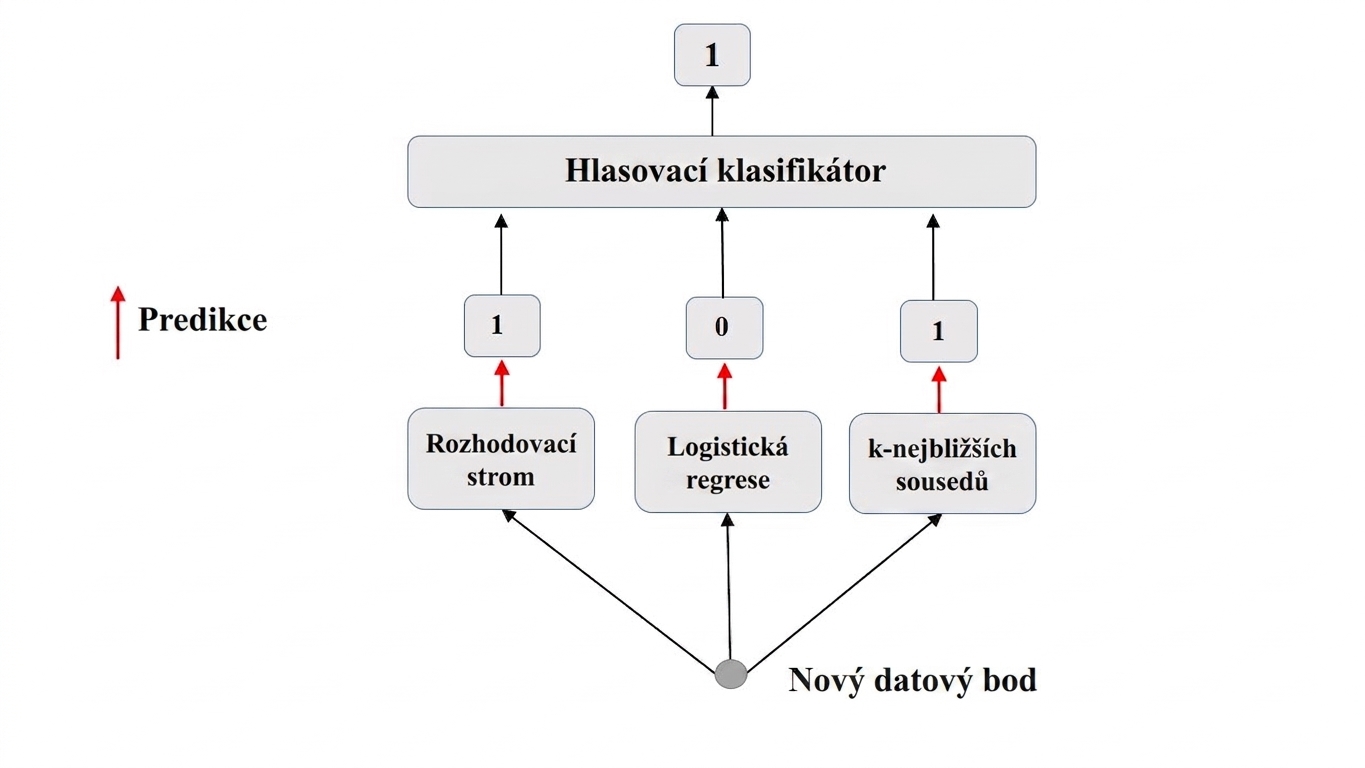
Ensemble Learning v praxi: Voting Classifier
Binární klasifikační úloha.
$N$ klasifikátorů vytvoří předpovědi: $P_1$, $P_2$, ..., $P_N$, kde $P_i$ = 0 nebo 1.
Předpověď meta-modelu: hard voting.
Hard Voting
VotingClassifier v sklearn (dataset Breast-Cancer)
# Import functions to compute accuracy and split data
from sklearn.metrics import accuracy_score
from sklearn.model_selection import train_test_split

# Import models, including VotingClassifier meta-model
from sklearn.linear_model import LogisticRegression
from sklearn.tree import DecisionTreeClassifier
from sklearn.neighbors import KNeighborsClassifier as KNN
from sklearn.ensemble import VotingClassifier

# Set seed for reproducibility
SEED = 1
VotingClassifier v sklearn (dataset Breast-Cancer)
# Split data into 70% train and 30% test X_train, X_test, y_train, y_test = train_test_split(X, y, test_size= 0.3, random_state= SEED) # Instantiate individual classifiers lr = LogisticRegression(random_state=SEED) knn = KNN() dt = DecisionTreeClassifier(random_state=SEED)# Define a list called classifier that contains the tuples (classifier_name, classifier) classifiers = [('Logistic Regression', lr), ('K Nearest Neighbours', knn), ('Classification Tree', dt)]
# Iterate over the defined list of tuples containing the classifiers
for clf_name, clf in classifiers:
    #fit clf to the training set
    clf.fit(X_train, y_train)

    # Predict the labels of the test set
    y_pred = clf.predict(X_test)

    # Evaluate the accuracy of clf on the test set
    print('{:s} : {:.3f}'.format(clf_name, accuracy_score(y_test, y_pred)))
Logistic Regression: 0.947
K Nearest Neighbours: 0.930
Classification Tree: 0.930
VotingClassifier v sklearn (dataset Breast-Cancer)
# Instantiate a VotingClassifier 'vc'
vc = VotingClassifier(estimators=classifiers)

# Fit 'vc' to the traing set and predict test set labels
vc.fit(X_train, y_train)
y_pred = vc.predict(X_test)

# Evaluate the test-set accuracy of 'vc'
print('Voting Classifier: {.3f}'.format(accuracy_score(y_test, y_pred)))
Voting Classifier: 0.953
Lass uns üben!
Machine Learning with Tree-Based Models in Python

