Podstawowy algorytm DQN

Głębokie uczenie ze wzmocnieniem w Pythonie

Timothée Carayol

Principal Machine Learning Engineer, Komment

Podstawowy DQN


  • Pierwszy krok do pełnego algorytmu DQN
  • Elementy:
    • Ogólna pętla treningu DRL
    • Sieć Q
    • Zasady Q-learningu
for episode in range(1000):
  state, info = env.reset()
  done = False
  while not done:
    # Action selection
    action = select_action(network, state)
    next_state, reward, terminated, truncated, _ = (
                                   env.step(action))
    done = terminated or truncated
    # Loss calculation
    loss = calculate_loss(network, state, action, 
                          next_state, reward, done)
    optimizer.zero_grad()
    loss.backward()
    optimizer.step()
    state = next_state
Głębokie uczenie ze wzmocnieniem w Pythonie

Wybór akcji w podstawowym DQN


def select_action(q_network, state):

# Feed state to network to obtain Q-values
q_values = q_network(state)
# Obtain index of action with highest Q-value action = torch.argmax(q_values).item()
return action
  • Polityka: wybierz akcję z najwyższą wartością Q
    • $ a_t = {\arg\max}_a Q(S_t, a) $
    • Tu: akcja 2 z wartością Q 0.12


Q-values: [-0.01, 0.08, 0.12, -0.07]

Action selected: 2, with q-value 0.12
Głębokie uczenie ze wzmocnieniem w Pythonie

Podstawowa funkcja straty DQN


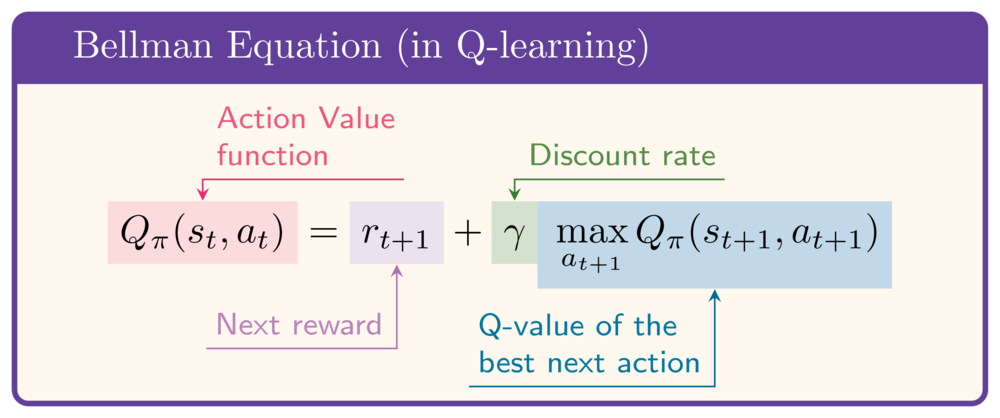
  • Funkcja wartości akcji spełnia równanie Bellmana
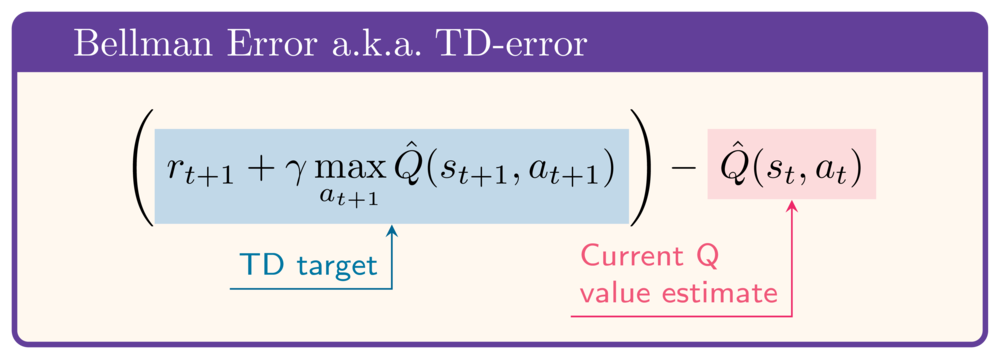
  • Idea: minimalizacja różnicy obu stron, tzw. błąd TD lub błąd Bellmana
  • Kwadratowy błąd Bellmana jako funkcja straty:
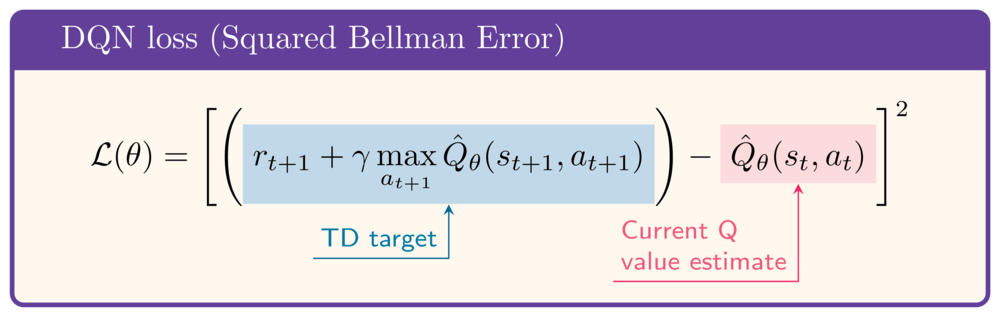
Strata DQN (kwadratowy błąd Bellmana): L(theta) = kwadrat błędu Bellmana


Równanie Bellmana Q(S,A) = nagroda + dyskonto * max(Q(S_nast,A))

Błąd Bellmana Q(S,A) - (nagroda + dyskonto * max(Q(S_nast,A)))

Głębokie uczenie ze wzmocnieniem w Pythonie

Podstawowa funkcja straty DQN

def calculate_loss(
      q_network, state, action,
      next_state, reward, done):

q_values = q_network(state)
current_state_q_value = q_values[action]
next_state_q_value = q_network(next_state).max()
target_q_value = reward + gamma * next_state_q_value * (1-done)
loss = nn.MSELoss()( current_state_q_value, target_q_value)
return loss
  • Wartość Q bieżącego stanu:

       $Q(s_t, a_t)$

  • Wartość Q następnego stanu:

       $\max_a Q(s_{t+1}, a)$

  • Docelowa wartość Q:

       $r_{t+1} + \gamma \max_a Q(s_{t+1}, a)$

  • Strata DQN:

$$\left(Q(s_t, a_t) - (r_{t+1} + \gamma \max_a Q(s_{t+1}, a)\right)^2$$

Głębokie uczenie ze wzmocnieniem w Pythonie

Opis epizodów

describe_episode(episode, reward, episode_reward, step)
| Episode    1 | Duration:   84 steps | Return: -871.38 | Crashed  |

| Episode 2 | Duration: 53 steps | Return: -452.68 | Crashed |
| Episode 3 | Duration: 57 steps | Return: -414.22 | Crashed | | Episode 4 | Duration: 54 steps | Return: -475.09 | Crashed |
| Episode 5 | Duration: 67 steps | Return: -532.31 | Crashed | | Episode 6 | Duration: 53 steps | Return: -407.00 | Crashed | | Episode 7 | Duration: 52 steps | Return: -380.45 | Crashed | | Episode 8 | Duration: 55 steps | Return: -380.75 | Crashed | | Episode 9 | Duration: 88 steps | Return: -688.68 | Crashed | | Episode 10 | Duration: 76 steps | Return: -338.06 | Crashed |
Głębokie uczenie ze wzmocnieniem w Pythonie

Czas na ćwiczenia!

Głębokie uczenie ze wzmocnieniem w Pythonie

Preparing Video For Download...