Weryfikacja założeń dotyczących średniej i wariancji
Modele GARCH w R

Kris Boudt
Professor of finance and econometrics
Weryfikacja 1: Średnia i odchylenie standardowe standaryzowanych zwrotów
Wzór na standaryzowane zwroty
$$ Z_{t} = \frac{R_{t} - \hat{\mu_{t}}}{ \hat{\sigma_{t}}} $$
- Pierwsza weryfikacja poprawności modelu:
- Średnia próbkowa standaryzowanych zwrotów $\approx$ 0
- Odchylenie standardowe próbkowe standaryzowanych zwrotów $\approx$ 1
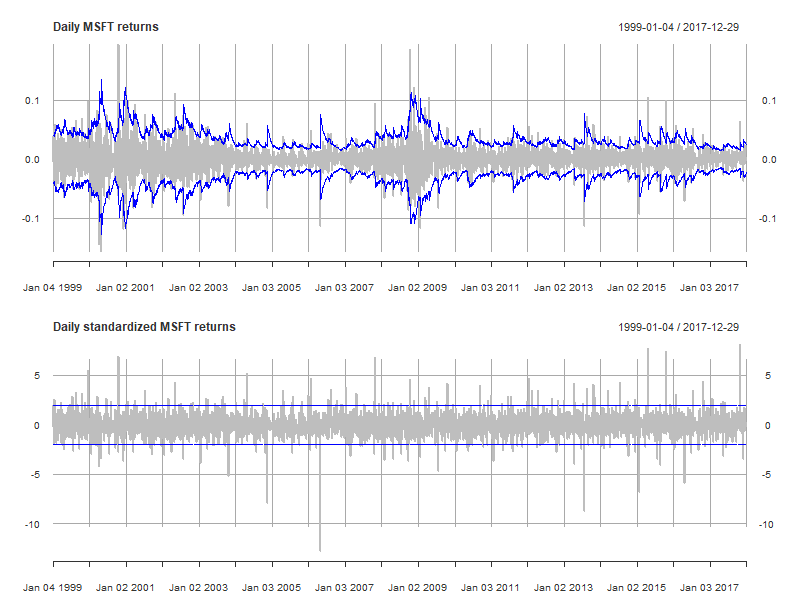
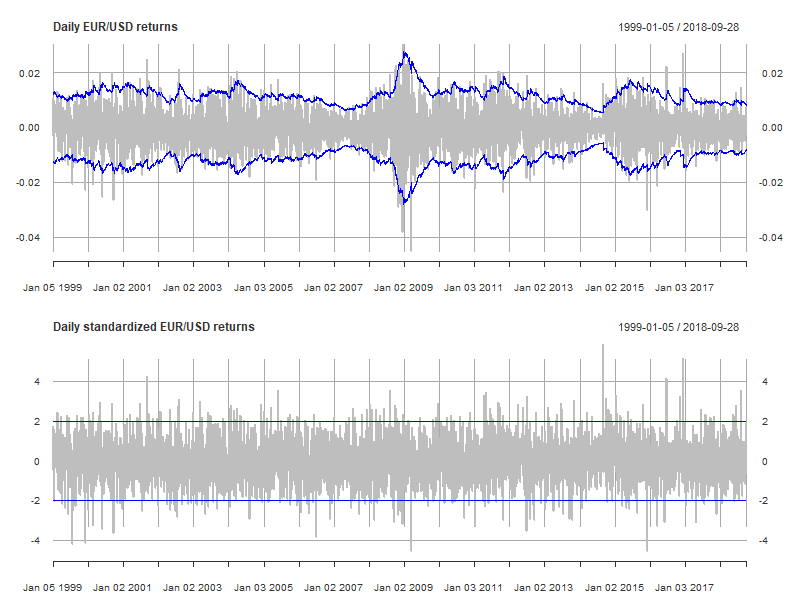
Weryfikacja 2: Wykres szeregu czasowego standaryzowanych zwrotów
- Druga weryfikacja poprawności modelu:
- wykres szeregu czasowego standaryzowanych zwrotów
- standaryzowane zwroty powinny mieć stałą zmienność
Weryfikacja 3: Brak przewidywalności w bezwzględnych zwrotach standaryzowanych
Trzecia weryfikacja poprawności modelu:
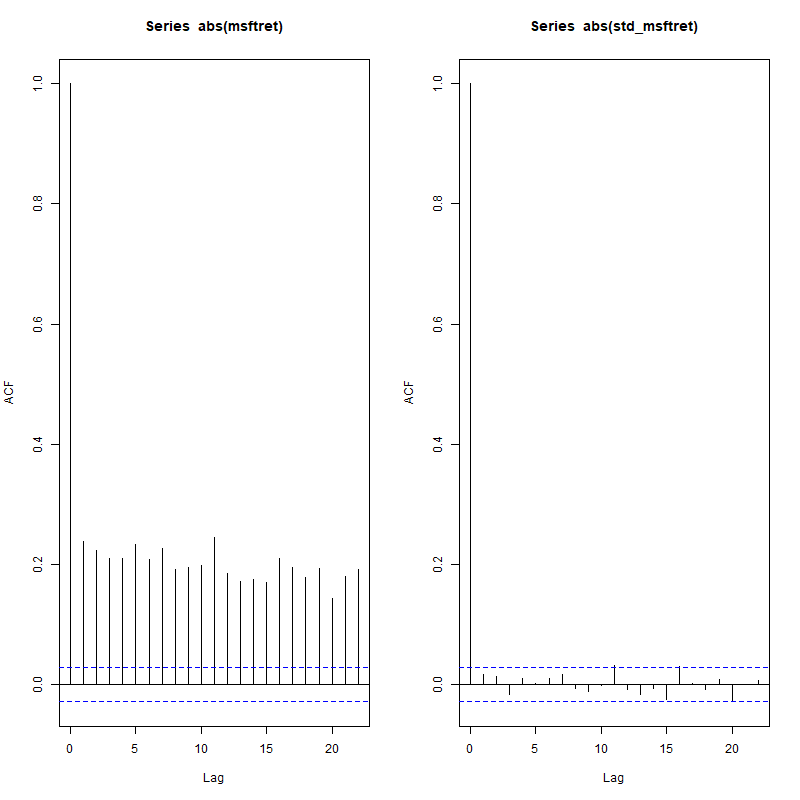
- sprawdzenie braku korelacji między przeszłymi a bieżącymi bezwzględnymi zwrotami standaryzowanymi.
- oznacza to: $ Corr(|Z_{t-k}|, |Z_{t}|) \approx 0, $ dla $k>0$
Dlaczego?
- Wielkość bezwzględnego zwrotu standaryzowanego powinna być stała $\rightarrow$ brak korelacji w bezwzględnych zwrotach standaryzowanych.
Autokorelacje
- Takie korelacje wewnątrz szeregu czasowego nazywane są autokorelacjami rzędu k
- $k=1$: $Corr(|Z_{t-1}|, |Z_{t}|)$: Korelacja bieżącego bezwzględnego zwrotu standaryzowanego z jego poprzednią wartością.
- $k=2$: $Corr(|Z_{t-2}|, |Z_{t}|)$: Korelacja bieżącego bezwzględnego zwrotu standaryzowanego z wartością sprzed dwóch okresów.
- ...
- Wszystkie powinny wynosić 0. Wyjątek:
- $k=0$: $Corr(|Z_{t}|, |Z_{t}|)$: Korelacja bezwzględnego zwrotu standaryzowanego z samym sobą: równa 1.
acf()
- W R autokorelacje obliczamy za pomocą funkcji autokorelacji
acf()- Wejście: szereg czasowy, maksymalny rząd
- Wyjście: korelogram: wykres wartości autokorelacji dla różnych rzędów $k = 0, 1, ...$.
Zastosowanie do MSFT
garchspec <- ugarchspec(mean.model = list(armaOrder = c(1, 0)),
                        variance.model = list(model = "gjrGARCH"),
                        distribution.model = "sstd")
garchfit <- ugarchfit(data = msftret, spec = garchspec)
stdmsftret <- residuals(garchfit, standardize = TRUE)
acf(abs(msftret), 22)
acf(abs(stdmsftret), 22)
Weryfikacja 4: Test Ljunga-Boxa
- Czwarta weryfikacja poprawności modelu:
- Test Ljunga-Boxa sprawdzający, czy pierwsze k autokorelacji bezwzględnych zwrotów standaryzowanych $|Z_t|$ wynoszą zero: $$ H_0: Corr(|Z_t|,|Z_{t-1}|) = Corr(|Z_t|,|Z_{t-2}|) = ... = Corr(|Z_t|,|Z_{t-k}|) = 0 $$
- Podobny do testu $t$ istotności statystycznej szacowanych parametrów, lecz tutaj oczekujemy wartości 0 dla dobrego modelu.
Reguła: wartość p poniżej 5% wskazuje, że użyty model jest niepoprawny.
Test Ljunga-Boxa w R
- W R: funkcja
Box.test()z 3 argumentami:- szereg
- maksymalny rząd, dla którego autokorelacje wynoszą zero
type = "Ljung-Box"
Przykład:
Box.test(abs(stdmsftret), 22, type = "Ljung-Box")
- Wynik: wartość p
- Reguła: wartość p poniżej 5% wskazuje, że użyty model jest niepoprawny.
Box.test dla bezwzględnych standaryzowanych zwrotów MSFT
Test na bezwzględnych standaryzowanych zwrotach:
Box.test(abs(stdmsftret), 22, type = "Ljung-Box")
    Box-Ljung test
data:  abs(stdmsftret)
X-squared = 25.246, df = 22, p-value = 0.2855
Uwaga: wartość p wynosi 28,55% > 5%. Nie możemy odrzucić, że: $$ H_0: Corr(|Z_t|,|Z_{t-1}|) = Corr(|Z_t|,|Z_{t-2}|) = ... = Corr(|Z_t|,|Z_{t-22}|) = 0 $$
Przeprowadźmy diagnostykę bezwzględnych standaryzowanych zwrotów.
Modele GARCH w R

