Introducere în regresia cu statsmodels în Python
Maarten Van den Broeck
Content Developer at DataCamp
| prezis fals | prezis adevărat | |
|---|---|---|
| actual fals | corect | fals pozitiv |
| actual adevărat | fals negativ | corect |
actual_response = churn["has_churned"]
predicted_response = np.round(mdl_recency.predict())
outcomes = pd.DataFrame({"actual_response": actual_response,
"predicted_response": predicted_response})
print(outcomes.value_counts(sort=False))
actual_response predicted_response
0 0.0 141
1.0 59
1 0.0 111
1.0 89
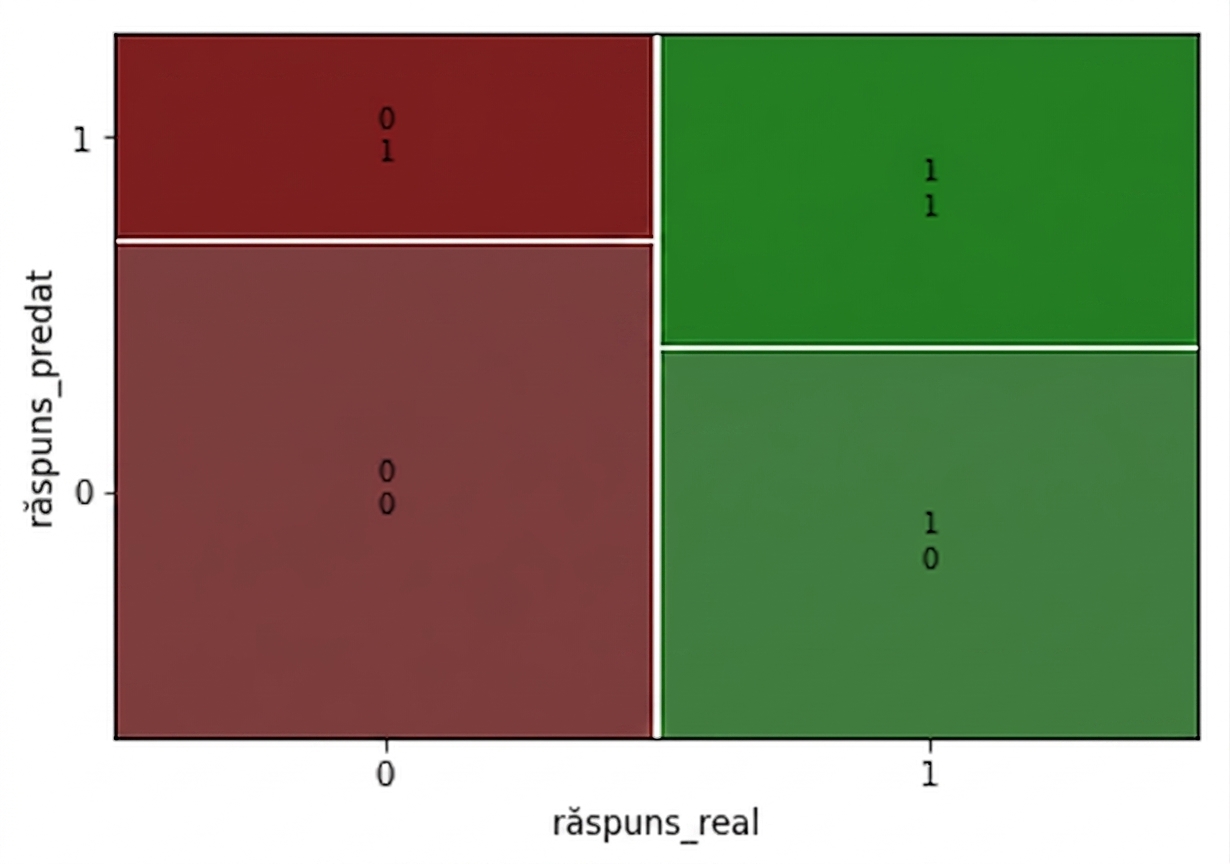
conf_matrix = mdl_recency.pred_table()
print(conf_matrix)
[[141. 59.]
[111. 89.]]
| adevărat negativ | fals pozitiv |
|---|---|
| fals negativ | adevărat pozitiv |
from statsmodels.graphics.mosaicplot
import mosaic
mosaic(conf_matrix)

Acuratețea este proporția de predicții corecte.
$$ \text{acuratețe} = \frac{TN + TP}{TN + FN + FP + TP} $$
[[141., 59.],
[111., 89.]]
TN = conf_matrix[0,0]
TP = conf_matrix[1,1]
FN = conf_matrix[1,0]
FP = conf_matrix[0,1]
acc = (TN + TP) / (TN + TP + FN + FP)
print(acc)
0.575
Sensibilitatea este proporția de pozitive reale.
$$ \text{sensibilitate} = \frac{TP}{FN + TP} $$
[[141., 59.],
[111., 89.]]
TN = conf_matrix[0,0]
TP = conf_matrix[1,1]
FN = conf_matrix[1,0]
FP = conf_matrix[0,1]
sens = TP / (FN + TP)
print(sens)
0.445
Specificitatea este proporția de negative reale.
$$ \text{specificitate} = \frac{TN}{TN + FP} $$
[[141., 59.],
[111., 89.]]
TN = conf_matrix[0,0]
TP = conf_matrix[1,1]
FN = conf_matrix[1,0]
FP = conf_matrix[0,1]
spec = TN / (TN + FP)
print(spec)
0.705
Introducere în regresia cu statsmodels în Python