Отслеживайте потери и точность на обучающей и валидационной выборках
Вычисление потерь на обучении
$$
На каждой эпохе:
Суммируйте потери по всем батчам в загрузчике данных
Вычислите среднее значение потерь по итогам эпохи
training_loss = 0.0

for inputs, labels in trainloader:
    # Run the forward pass
    outputs = model(inputs)
    # Compute the loss
    loss = criterion(outputs, labels)

    # Backpropagation
    loss.backward()  # Compute gradients
    optimizer.step()  # Update weights
    optimizer.zero_grad()  # Reset gradients


    # Calculate and sum the loss
    training_loss += loss.item()

epoch_loss = training_loss / len(trainloader)
Вычисление потерь на валидации
validation_loss = 0.0
model.eval() # Put model in evaluation mode


with torch.no_grad(): # Disable gradients for efficiency

  for inputs, labels in validationloader:
     # Run the forward pass
     outputs = model(inputs)
     # Calculate the loss
     loss = criterion(outputs, labels)
     validation_loss += loss.item()

epoch_loss = validation_loss / len(validationloader) # Compute mean loss

model.train() # Switch back to training mode
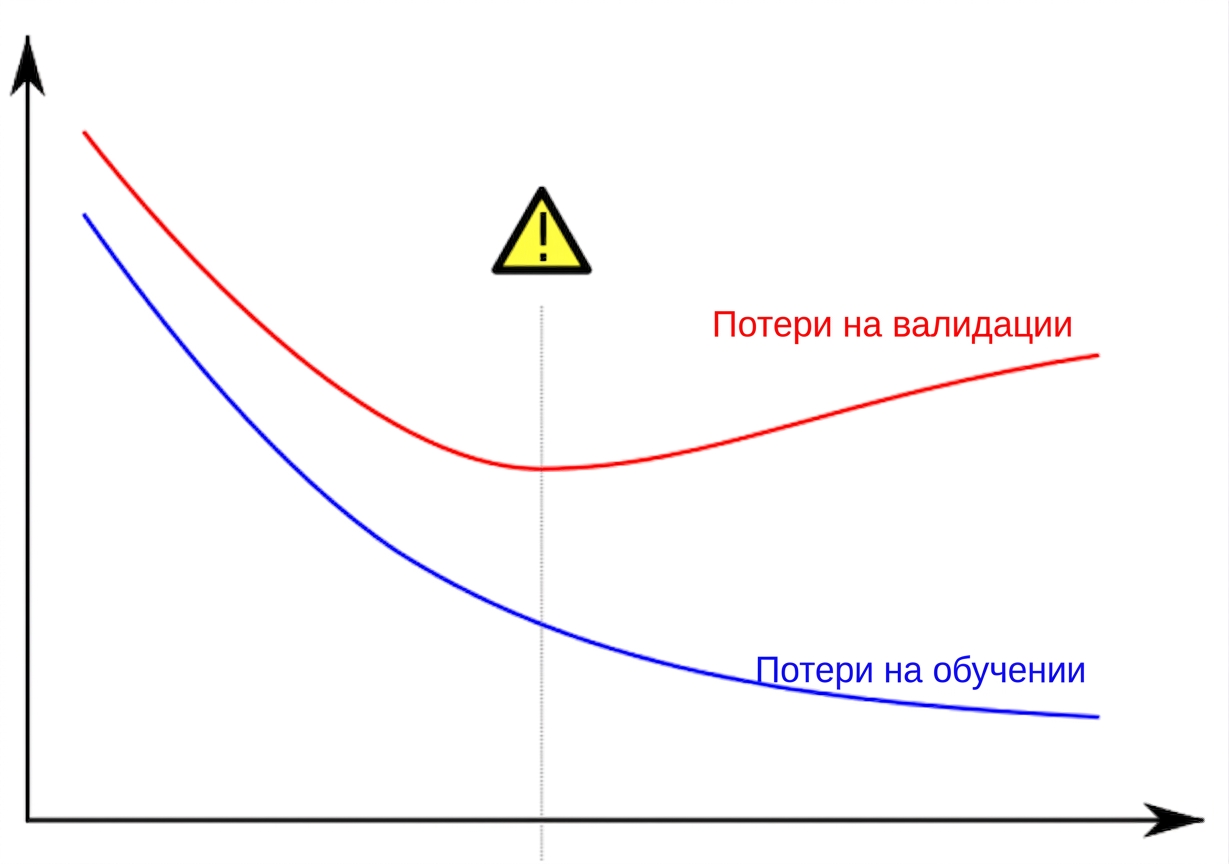
Переобучение
Вычисление точности с помощью torchmetrics
import torchmetrics


# Create accuracy metric
metric = torchmetrics.Accuracy(task="multiclass", num_classes=3)


for features, labels in dataloader:
    outputs = model(features)  # Forward pass
    # Compute batch accuracy (keeping argmax for one-hot labels)
    metric.update(outputs, labels.argmax(dim=-1))


# Compute accuracy over the whole epoch
accuracy = metric.compute()


# Reset metric for the next epoch
metric.reset()