Bias और Variance की समस्याओं का निदान
Python में Tree-Based Models के साथ Machine Learning

Elie Kawerk
Data Scientist
Generalization Error का अनुमान
हम किसी मॉडल की generalization error का अनुमान कैसे लगाएँ?
सीधे नहीं कर सकते क्योंकि:
$f$ अज्ञात है,
आमतौर पर आपके पास केवल एक डेटासेट होता है,
noise अप्रत्याशित है.
Generalization Error का अनुमान
समाधान:
- डेटा को training और test सेट में बाँटें,
- $\hat{f}$ को training सेट पर फिट करें,
- unseen test सेट पर $\hat{f}$ की error मापें.
- $\hat{f}$ की generalization error $\approx$ test सेट error.
Cross-Validation से बेहतर मूल्यांकन
जब तक आप $\hat{f}$ के प्रदर्शन पर आश्वस्त न हों, test सेट को न छुएँ.
training सेट पर $\hat{f}$ का मूल्यांकन: biased estimate, $\hat{f}$ ने सभी training पॉइंट पहले ही देख लिए हैं.
समाधान $\rightarrow$ Cross-Validation (CV):
K-Fold CV,
Hold-Out CV.
K-Fold CV
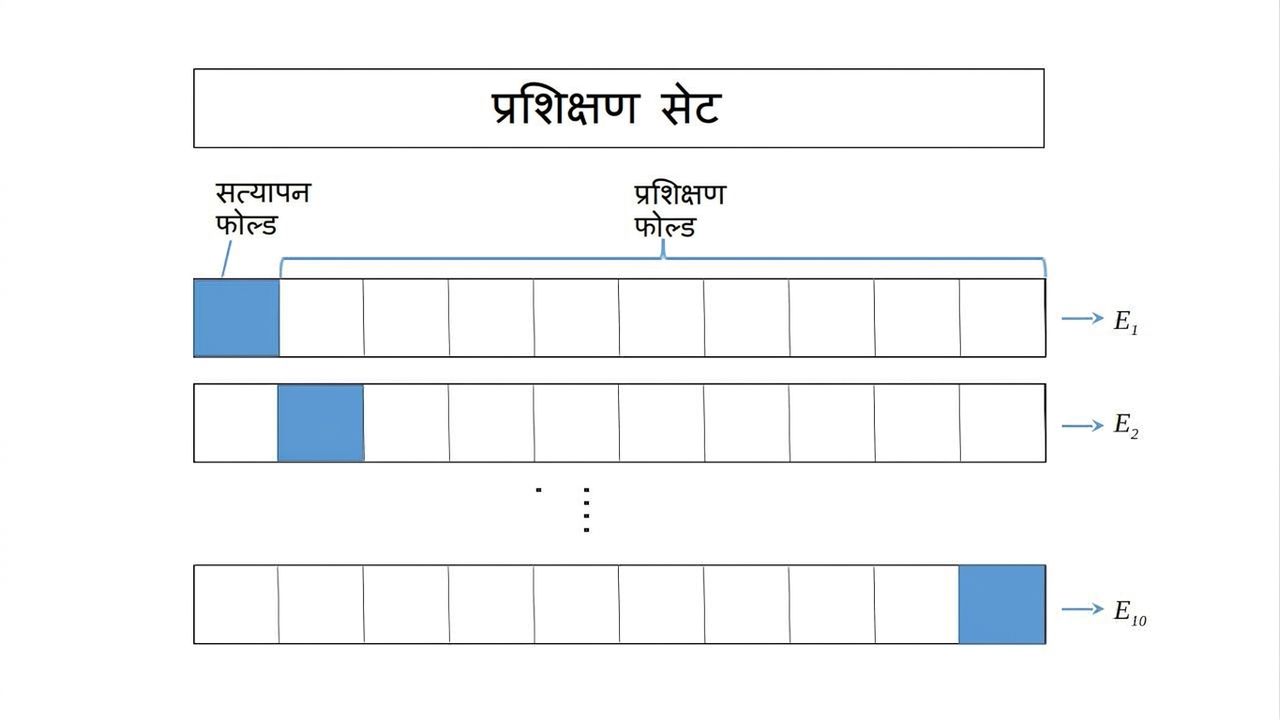
K-Fold CV
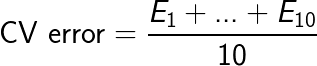
Variance समस्याओं का निदान
अगर $\hat{f}$ में high variance है:
$\hat{f}$ की CV error > training सेट error.
- $\hat{f}$ training सेट पर overfit करता है. Overfitting कम करने के तरीके:
- मॉडल complexity घटाएँ,
- जैसे: max depth घटाएँ, min samples per leaf बढ़ाएँ, ...
- ज़्यादा डेटा जुटाएँ, ..
Bias समस्याओं का निदान
अगर $\hat{f}$ में high bias है:
$\hat{f}$ की CV error $\approx$ training सेट error >> वांछित error.
$\hat{f}$ training सेट को underfit करता है. Underfitting कम करने के तरीके:
- मॉडल complexity बढ़ाएँ
- जैसे: max depth बढ़ाएँ, min samples per leaf घटाएँ, ...
- और प्रासंगिक फीचर जुटाएँ
Auto डेटासेट पर sklearn में K-Fold CV
from sklearn.tree import DecisionTreeRegressor from sklearn.model_selection import train_test_split from sklearn.metrics import mean_squared_error as MSE from sklearn.model_selection import cross_val_score# Set seed for reproducibility SEED = 123 # Split data into 70% train and 30% test X_train, X_test, y_train, y_test = train_test_split(X,y, test_size=0.3, random_state=SEED)# Instantiate decision tree regressor and assign it to 'dt' dt = DecisionTreeRegressor(max_depth=4, min_samples_leaf=0.14, random_state=SEED)
Auto डेटासेट पर sklearn में K-Fold CV
# Evaluate the list of MSE ontained by 10-fold CV # Set n_jobs to -1 in order to exploit all CPU cores in computation MSE_CV = - cross_val_score(dt, X_train, y_train, cv= 10, scoring='neg_mean_squared_error', n_jobs = -1)# Fit 'dt' to the training set dt.fit(X_train, y_train) # Predict the labels of training set y_predict_train = dt.predict(X_train) # Predict the labels of test set y_predict_test = dt.predict(X_test)
# CV MSE
print('CV MSE: {:.2f}'.format(MSE_CV.mean()))
CV MSE: 20.51
# Training set MSE
print('Train MSE: {:.2f}'.format(MSE(y_train, y_predict_train)))
Train MSE: 15.30
# Test set MSE
print('Test MSE: {:.2f}'.format(MSE(y_test, y_predict_test)))
Test MSE: 20.92
अभ्यास करते हैं!
Python में Tree-Based Models के साथ Machine Learning

