PyTorch और ऑब्जेक्ट-ओरिएंटेड प्रोग्रामिंग
इंटरमीडिएट Deep Learning with PyTorch

Michal Oleszak
Machine Learning Engineer
हम क्या सीखेंगे
मजबूत डीप लर्निंग मॉडल कैसे ट्रेन करें:
- Optimizers से ट्रेनिंग बेहतर करें
- Vanishing/Exploding gradients घटाएँ
- Convolutional Neural Networks (CNNs)
- Recurrent Neural Networks (RNNs)
- Multi-input और multi-output मॉडल्स

Prerequisites
कोर्स यह मानता है कि आप इन विषयों में सहज हैं:
Neural networks training:
- Forward pass
- Loss calculation
- Backward pass (backpropagation)
PyTorch से मॉडल ट्रेनिंग:
- Datasets और DataLoaders
- Model training loop
- Model evaluation
पूर्व-आवश्यक कोर्स: Introduction to Deep Learning with PyTorch
Object-Oriented Programming (OOP)
हम OOP से इन्हें परिभाषित करेंगे:
- PyTorch Datasets
- PyTorch Models
OOP में, हम ऑब्जेक्ट बनाते हैं जिनमें:
- क्षमताएँ (methods)
- डेटा (attributes)
Object-Oriented Programming (OOP)
class BankAccount:
    def __init__(self, balance):
        self.balance = balance
__init__तब कॉल होता है जबBankAccountऑब्जेक्ट बनता हैbalanceBankAccountऑब्जेक्ट का attribute है
account = BankAccount(100)
print(account.balance)
100
Object-Oriented Programming (OOP)
- Methods: काम करने के लिए Python functions
depositmethod बैलेंस बढ़ाता है
class BankAccount: def __init__(self, balance): self.balance = balancedef deposit(self, amount): self.balance += amount
account = BankAccount(100)
account.deposit(50)
print(account.balance)
150
Water potability डेटासेट
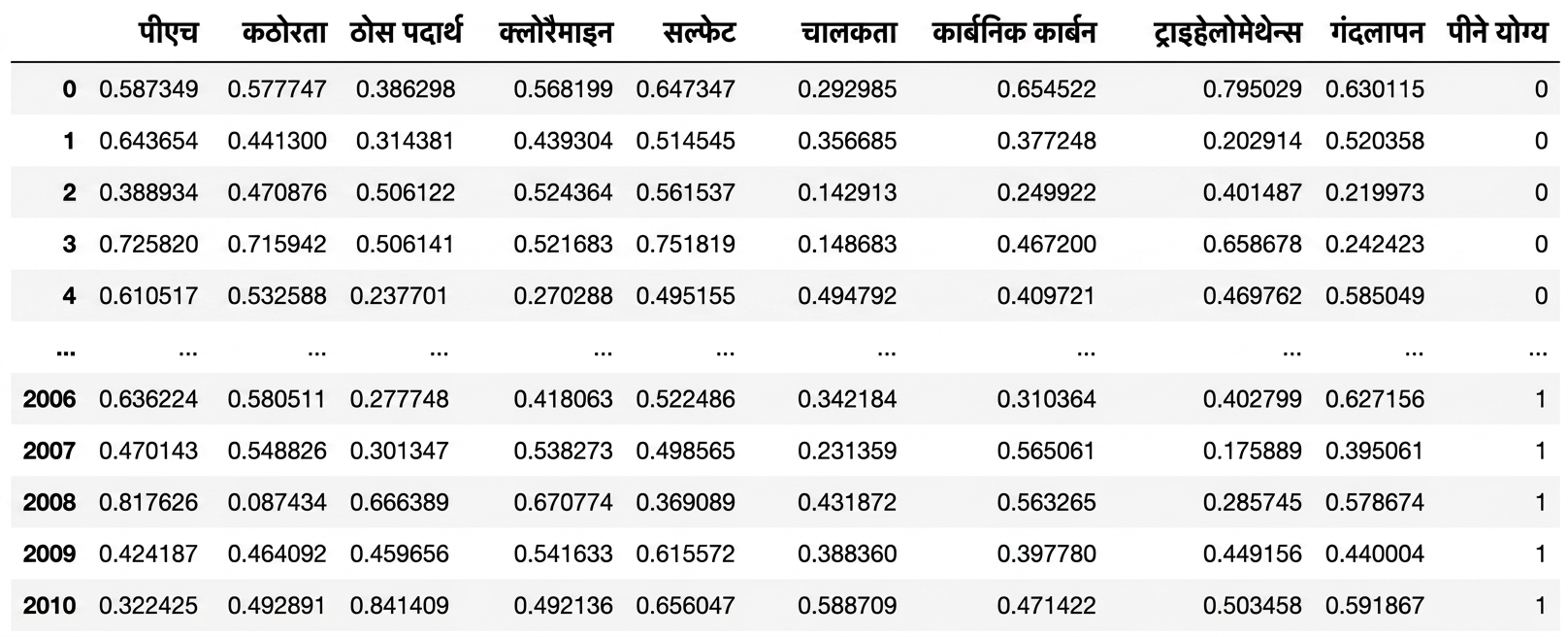
PyTorch Dataset
from torch.utils.data import Dataset class WaterDataset(Dataset):def __init__(self, csv_path): super().__init__() df = pd.read_csv(csv_path) self.data = df.to_numpy()def __len__(self): return self.data.shape[0]def __getitem__(self, idx): features = self.data[idx, :-1] label = self.data[idx, -1] return features, label
- init: डेटा लोड करें, numpy array में स्टोर करें
super().__init__()सुनिश्चित करता है किWaterDatasettorchDatasetजैसा व्यवहार करे
- len: डेटासेट का आकार लौटाएँ
- getitem:
- एक आर्ग्युमेंट
idxलेता है - इंडेक्स
idxपर सिंगल sample के features और label लौटाता है
- एक आर्ग्युमेंट
PyTorch DataLoader
dataset_train = WaterDataset(
    "water_train.csv"
)
from torch.utils.data import DataLoader

dataloader_train = DataLoader(
    dataset_train,
    batch_size=2,
    shuffle=True,
)
features, labels = next(iter(dataloader_train))
print(f"Features: {features},\nLabels: {labels}")
Features: tensor([
  [0.4899, 0.4180, 0.6299, 0.3496, 0.4575,
   0.3615, 0.3259, 0.5011, 0.7545],
  [0.7953, 0.6305, 0.4480, 0.6549, 0.7813,
   0.6566, 0.6340, 0.5493, 0.5789]
]),
Labels: tensor([1., 0.])
PyTorch मॉडल
Sequential मॉडल परिभाषा:
net = nn.Sequential(
  nn.Linear(9, 16),
  nn.ReLU(),
  nn.Linear(16, 8),
  nn.ReLU(),
  nn.Linear(8, 1),
  nn.Sigmoid(),
)
क्लास-आधारित मॉडल परिभाषा:
class Net(nn.Module):def __init__(self): super().__init__() self.fc1 = nn.Linear(9, 16) self.fc2 = nn.Linear(16, 8) self.fc3 = nn.Linear(8, 1)def forward(self, x): x = nn.functional.relu(self.fc1(x)) x = nn.functional.relu(self.fc2(x)) x = nn.functional.sigmoid(self.fc3(x)) return x net = Net()
अभ्यास करते हैं!
इंटरमीडिएट Deep Learning with PyTorch

