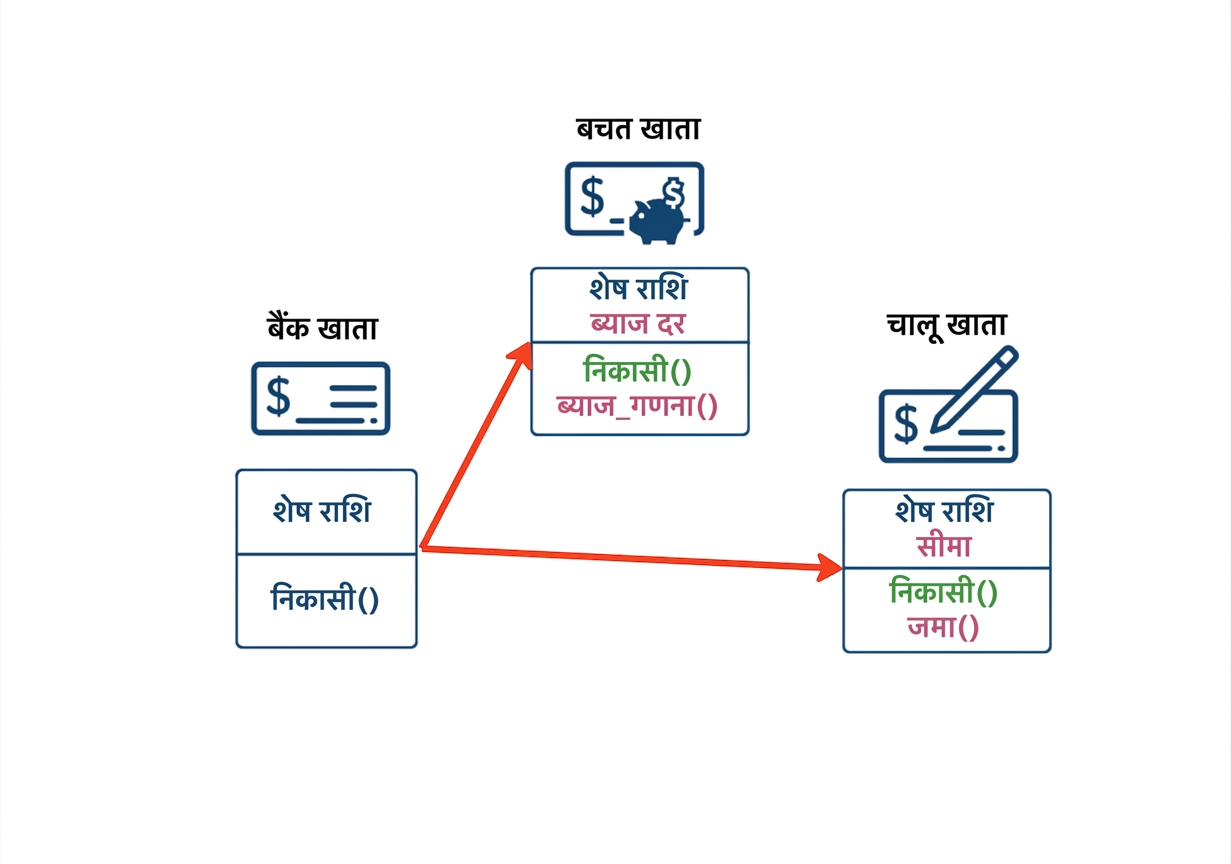
class BankAccount:
    def __init__(self, balance):
       self.balance = balance

    def withdraw(self, amount):
       self.balance -=amount

# Empty class inherited from BankAccount
class SavingsAccount(BankAccount):
    pass
कंस्ट्रक्टर कस्टमाइज़ करना
class SavingsAccount(BankAccount):
    # Constructor for SavingsAccount with an additional argument
    def __init__(self, balance, interest_rate):

        # Call the parent constructor using ClassName.__init__()
        # self is a SavingsAccount but also a BankAccount
        BankAccount.__init__(self, balance)

        # Add more functionality
        self.interest_rate = interest_rate
Parent.__init__(self, args...){{1}} से पहले पैरेंट कंस्ट्रक्टर चला सकते हैं
और फ़ंक्शनैलिटी जोड़ें
पैरेंट कंस्ट्रक्टर कॉल करना अनिवार्य नहीं है
कस्टम कंस्ट्रक्टर से ऑब्जेक्ट बनाएँ
# Construct the object using the new constructor
acct = SavingsAccount(1000, 0.03)
acct.interest_rate
0.03
फ़ंक्शनैलिटी जोड़ना
सामान्य रूप से मेथड जोड़ें
पैरेंट और चाइल्ड दोनों क्लास का डेटा इस्तेमाल कर सकते हैं
class CheckingAccount(BankAccount):

    def __init__(self, balance, limit):
        BankAccount.__init__(self, balance) # Call the ParentClass constructor
        self.limit = limit

    def deposit(self, amount):
        self.balance += amount

    def withdraw(self, amount, fee=0): # New fee argument

        if amount <= self.limit:
            BankAccount.withdraw(self, amount + fee)
        else:
            pass # Won't run if the condition isn't met
check_acct = CheckingAccount(1000, 25)

# Will call withdraw from CheckingAccount
check_acct.withdraw(200)


# Will call withdraw from CheckingAccount
check_acct.withdraw(200, fee=15)
bank_acct = BankAccount(1000)

# Will call withdraw from BankAccount
bank_acct.withdraw(200)


# Will produce an error
bank_acct.withdraw(200, fee=15)
TypeError: withdraw() got an unexpected
keyword argument 'fee'