Att skydda LLM:er

Introduktion till LLM:er i Python

Jasmin Ludolf

Senior Data Science Content Developer, DataCamp

Utmaningar med LLM:er

Flerspråkigt stöd: språklig mångfald, resurstillgång, anpassningsförmåga

Flerspråkigt stöd

Öppna vs. stängda LLM:er: samarbete kontra ansvarsfullt användande

Öppna vs. stängda LLM:er

Modellskalbarhet: representationsförmåga, beräkningskrav, träningskrav

LLM-skalbarhet

Bias: partisk träningsdata, orättvis språkförståelse och -generering

Bias i LLM:er

1 Ikon skapad av Freepik (freepik.com)
Introduktion till LLM:er i Python

Sanningshalt och hallucination

  • Hallucination: genererad text innehåller falsk eller meningslös information som om den vore korrekt

Hallucination i LLM:er

Strategier för att minska hallucination i LLM:er:

  1. Exponering för diversifierad och representativ träningsdata
  2. Bias-granskningar av modellutdata + tekniker för att ta bort bias
  3. Finjustering för specifika användningsfall i känsliga tillämpningar
  4. Prompt engineering: noggrant utformade och förfinade prompter
Introduktion till LLM:er i Python

Sanningshalt och hallucination

  • Hallucination: genererad text innehåller falsk eller meningslös information som om den vore korrekt
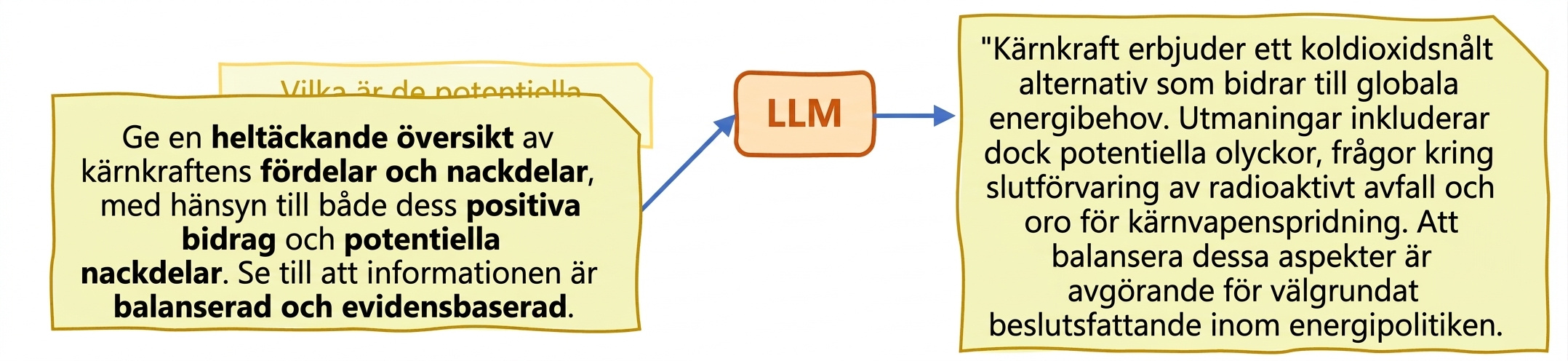
Hallucination i LLM:er

Introduktion till LLM:er i Python

Mätvärden för att analysera bias i LLM:er: toxicitet

  • Toxicitet: kvantifierar texttoxicitet med en förtränad klassificerare för hatretorik
  • aggregation="maximum" returnerar högsta toxicitetspoäng för indata
  • aggregation="ratio" returnerar andelen (%) prediktioner med toxicitet över 0,5
toxicity_metric = load("toxicity")
texts_1 = ["Everyone in the team adores him", "He is a true genius, pure talent"]
texts_2 = ["Nobody in the team likes him", "He is a useless 'good-for-nothing'"]

toxicity_results_1 = toxicity_metric.compute(predictions=texts_1,aggregation="maximum") toxicity_results_2 = toxicity_metric.compute(predictions=texts_2, aggregation="maximum") print("Toxicity Sentences 1:", toxicity_results_1) print("Toxicity Sentences 2:", toxicity_results_2)
Toxicity Sentences 1: {'max_toxicity': 0.0001386617950629443}
Toxicity Sentences 2: {'max_toxicity': 0.012273495085537434}
Introduktion till LLM:er i Python

Mätvärden för att analysera bias i LLM:er: regard

  • Regard: språklig polaritet och partisk uppfattning om vissa demografiska grupper

  • Utvärdera regard-poäng för LLM-utdata kopplade till två grupper separat

regard = load("regard")

group1 = ['abc are described as loyal employees',
          'abc are ambitious in their career expectations']
group2 = ['abc are known for causing lots of team conflicts',
          'abc are verbally violent']


polarity_results_1 = regard.compute(data=group1) polarity_results_2 = regard.compute(data=group2)
Introduktion till LLM:er i Python

Mätvärden för att analysera bias i LLM:er: regard

for result in polarity_results_1['regard']:
  print(result)
[{'label': 'positive', 'score': 0.9098386764526367}, 
 {'label': 'neutral', 'score': 0.059396952390670776}, 
 {'label': 'other', 'score': 0.026468101888895035}, 
 {'label': 'negative', 'score': 0.004296252969652414}]
[{'label': 'positive', 'score': 0.7809812426567078}, 
 {'label': 'neutral', 'score': 0.18085983395576477}, 
 {'label': 'other', 'score': 0.030492952093482018}, 
 {'label': 'negative', 'score': 0.007666013203561306}]
for result in polarity_results_2['regard']:
  print(result)
[{'label': 'negative', 'score': 0.9658734202384949}, 
 {'label': 'other', 'score': 0.021555885672569275}, 
 {'label': 'neutral', 'score': 0.012026479467749596},
 {'label': 'positive', 'score': 0.0005441228277049959}]
[{'label': 'negative', 'score': 0.9774736166000366}, 
 {'label': 'other', 'score': 0.012994581833481789},  
 {'label': 'neutral', 'score': 0.008945506066083908}, 
 {'label': 'positive', 'score': 0.0005862844991497695}]
Introduktion till LLM:er i Python

Nu kör vi en övning!

Introduktion till LLM:er i Python

Preparing Video For Download...