การวินิจฉัยปัญหา Bias และ Variance
Machine Learning with Tree-Based Models in Python

Elie Kawerk
Data Scientist
การประเมิน Generalization Error
เราประเมิน generalization error ของโมเดลได้อย่างไร?
ไม่สามารถทำได้โดยตรง เพราะ:
$f$ ไม่เป็นที่รู้จัก
โดยทั่วไปมีชุดข้อมูลเพียงชุดเดียว
noise ไม่สามารถคาดเดาได้
การประเมิน Generalization Error
วิธีแก้ไข:
- แบ่งข้อมูลเป็น training set และ test set
- fit $\hat{f}$ กับ training set
- ประเมิน error ของ $\hat{f}$ บน test set ที่ยังไม่เคยเห็น
- generalization error ของ $\hat{f} \approx$ test set error ของ $\hat{f}$
การประเมินโมเดลที่ดีขึ้นด้วย Cross-Validation
ไม่ควรแตะต้อง test set จนกว่าจะมั่นใจในประสิทธิภาพของ $\hat{f}$
การประเมิน $\hat{f}$ บน training set ให้ค่าที่มี bias เพราะ $\hat{f}$ เห็นข้อมูลทั้งหมดแล้ว
วิธีแก้ไข $\rightarrow$ Cross-Validation (CV):
K-Fold CV
Hold-Out CV
K-Fold CV

K-Fold CV
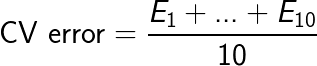
การวินิจฉัยปัญหา Variance
หาก $\hat{f}$ มีปัญหา high variance:
CV error ของ $\hat{f}$ > training set error ของ $\hat{f}$
- กล่าวได้ว่า $\hat{f}$ เกิด overfitting กับ training set วิธีแก้ไข:
- ลดความซับซ้อนของโมเดล
- เช่น ลด max depth, เพิ่ม min samples per leaf, ...
- เก็บข้อมูลเพิ่มเติม ...
การวินิจฉัยปัญหา Bias
หาก $\hat{f}$ มีปัญหา high bias:
CV error ของ $\hat{f} \approx$ training set error ของ $\hat{f} >>$ ค่า error ที่ต้องการ
กล่าวได้ว่า $\hat{f}$ เกิด underfitting กับ training set วิธีแก้ไข:
- เพิ่มความซับซ้อนของโมเดล
- เช่น เพิ่ม max depth, ลด min samples per leaf, ...
- เก็บ feature ที่เกี่ยวข้องเพิ่มเติม
K-Fold CV ใน sklearn บน Auto Dataset
from sklearn.tree import DecisionTreeRegressor from sklearn.model_selection import train_test_split from sklearn.metrics import mean_squared_error as MSE from sklearn.model_selection import cross_val_score# Set seed for reproducibility SEED = 123 # Split data into 70% train and 30% test X_train, X_test, y_train, y_test = train_test_split(X,y, test_size=0.3, random_state=SEED)# Instantiate decision tree regressor and assign it to 'dt' dt = DecisionTreeRegressor(max_depth=4, min_samples_leaf=0.14, random_state=SEED)
K-Fold CV ใน sklearn บน Auto Dataset
# Evaluate the list of MSE ontained by 10-fold CV # Set n_jobs to -1 in order to exploit all CPU cores in computation MSE_CV = - cross_val_score(dt, X_train, y_train, cv= 10, scoring='neg_mean_squared_error', n_jobs = -1)# Fit 'dt' to the training set dt.fit(X_train, y_train) # Predict the labels of training set y_predict_train = dt.predict(X_train) # Predict the labels of test set y_predict_test = dt.predict(X_test)
# CV MSE
print('CV MSE: {:.2f}'.format(MSE_CV.mean()))
CV MSE: 20.51
# Training set MSE
print('Train MSE: {:.2f}'.format(MSE(y_train, y_predict_train)))
Train MSE: 15.30
# Test set MSE
print('Test MSE: {:.2f}'.format(MSE(y_test, y_predict_test)))
Test MSE: 20.92
มาฝึกกันเถอะ!
Machine Learning with Tree-Based Models in Python

