Machine Learning with Tree-Based Models in Python
Elie Kawerk
Data Scientist
Base estimator: Decision Tree, Logistic Regression, Neural Net, ...
แต่ละ estimator ถูกเทรนบน bootstrap sample ที่แตกต่างกันของชุดข้อมูลเทรน
estimator ใช้ฟีเจอร์ทั้งหมดในการเทรนและพยากรณ์
Base estimator: Decision Tree
แต่ละ estimator ถูกเทรนบน bootstrap sample ที่ต่างกัน โดยมีขนาดเท่ากับชุดข้อมูลเทรน
RF เพิ่มความหลากหลายในการเทรนต้นไม้แต่ละต้น
สุ่มเลือก $d$ ฟีเจอร์ที่แต่ละโหนดโดยไม่ซ้ำ
( $d < \text{total number of features}$ )


การจำแนกประเภท:
RandomForestClassifier ใน scikit-learn การถดถอย:
RandomForestRegressor ใน scikit-learn# Basic imports
from sklearn.ensemble import RandomForestRegressor
from sklearn.model_selection import train_test_split
from sklearn.metrics import mean_squared_error as MSE
# Set seed for reproducibility
SEED = 1
# Split dataset into 70% train and 30% test
X_train, X_test, y_train, y_test = train_test_split(X, y,
test_size=0.3,
random_state=SEED)
# Instantiate a random forests regressor 'rf' 400 estimators rf = RandomForestRegressor(n_estimators=400, min_samples_leaf=0.12, random_state=SEED)# Fit 'rf' to the training set rf.fit(X_train, y_train) # Predict the test set labels 'y_pred' y_pred = rf.predict(X_test)
# Evaluate the test set RMSE
rmse_test = MSE(y_test, y_pred)**(1/2)
# Print the test set RMSE
print('Test set RMSE of rf: {:.2f}'.format(rmse_test))
Test set RMSE of rf: 3.98
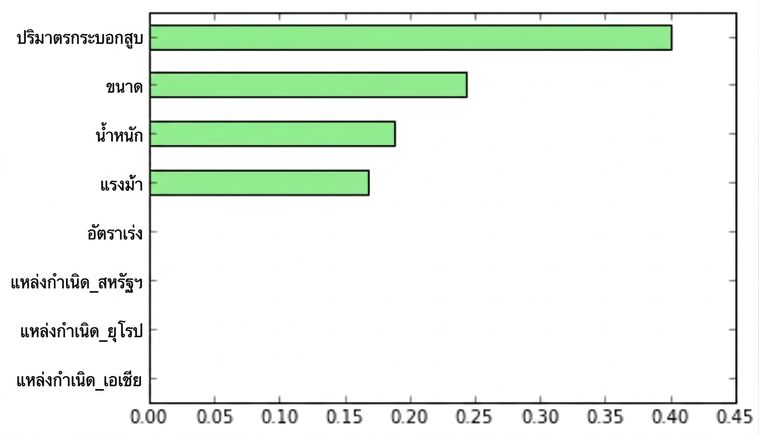
วิธีที่ใช้ต้นไม้: สามารถวัดความสำคัญของแต่ละฟีเจอร์ในการพยากรณ์ได้
ใน sklearn:
feature_importance_import pandas as pd
import matplotlib.pyplot as plt
# Create a pd.Series of features importances
importances_rf = pd.Series(rf.feature_importances_, index = X.columns)
# Sort importances_rf
sorted_importances_rf = importances_rf.sort_values()
# Make a horizontal bar plot
sorted_importances_rf.plot(kind='barh', color='lightgreen'); plt.show()

Machine Learning with Tree-Based Models in Python