PyTorch และการเขียนโปรแกรมเชิงวัตถุ
Deep Learning ระดับกลางด้วย PyTorch

Michal Oleszak
Machine Learning Engineer
สิ่งที่จะได้เรียนรู้
วิธีฝึกโมเดล deep learning ให้มีประสิทธิภาพ:
- การปรับปรุงการฝึกด้วย optimizer
- การจัดการปัญหา vanishing และ exploding gradients
- Convolutional Neural Networks (CNNs)
- Recurrent Neural Networks (RNNs)
- โมเดลแบบ multi-input และ multi-output

ความรู้พื้นฐาน
คอร์สนี้ต้องการให้คุ้นเคยกับหัวข้อต่อไปนี้:
การฝึก Neural network:
- Forward pass
- การคำนวณ Loss
- Backward pass (backpropagation)
การฝึกโมเดลด้วย PyTorch:
- Datasets และ DataLoaders
- ลูปการฝึกโมเดล
- การประเมินโมเดล
คอร์สที่ต้องเรียนก่อน: Introduction to Deep Learning with PyTorch
การเขียนโปรแกรมเชิงวัตถุ (OOP)
จะใช้ OOP ในการกำหนด:
- PyTorch Datasets
- PyTorch Models
ใน OOP เราสร้างออบเจกต์ที่มี:
- ความสามารถ (methods)
- ข้อมูล (attributes)
การเขียนโปรแกรมเชิงวัตถุ (OOP)
class BankAccount:
    def __init__(self, balance):
        self.balance = balance
__init__จะถูกเรียกเมื่อสร้างออบเจกต์BankAccountbalanceคือ attribute ของออบเจกต์BankAccount
account = BankAccount(100)
print(account.balance)
100
การเขียนโปรแกรมเชิงวัตถุ (OOP)
- Methods: ฟังก์ชัน Python สำหรับดำเนินงานต่าง ๆ
- method
depositเพิ่มยอดคงเหลือ
class BankAccount: def __init__(self, balance): self.balance = balancedef deposit(self, amount): self.balance += amount
account = BankAccount(100)
account.deposit(50)
print(account.balance)
150
ชุดข้อมูลคุณภาพน้ำดื่ม
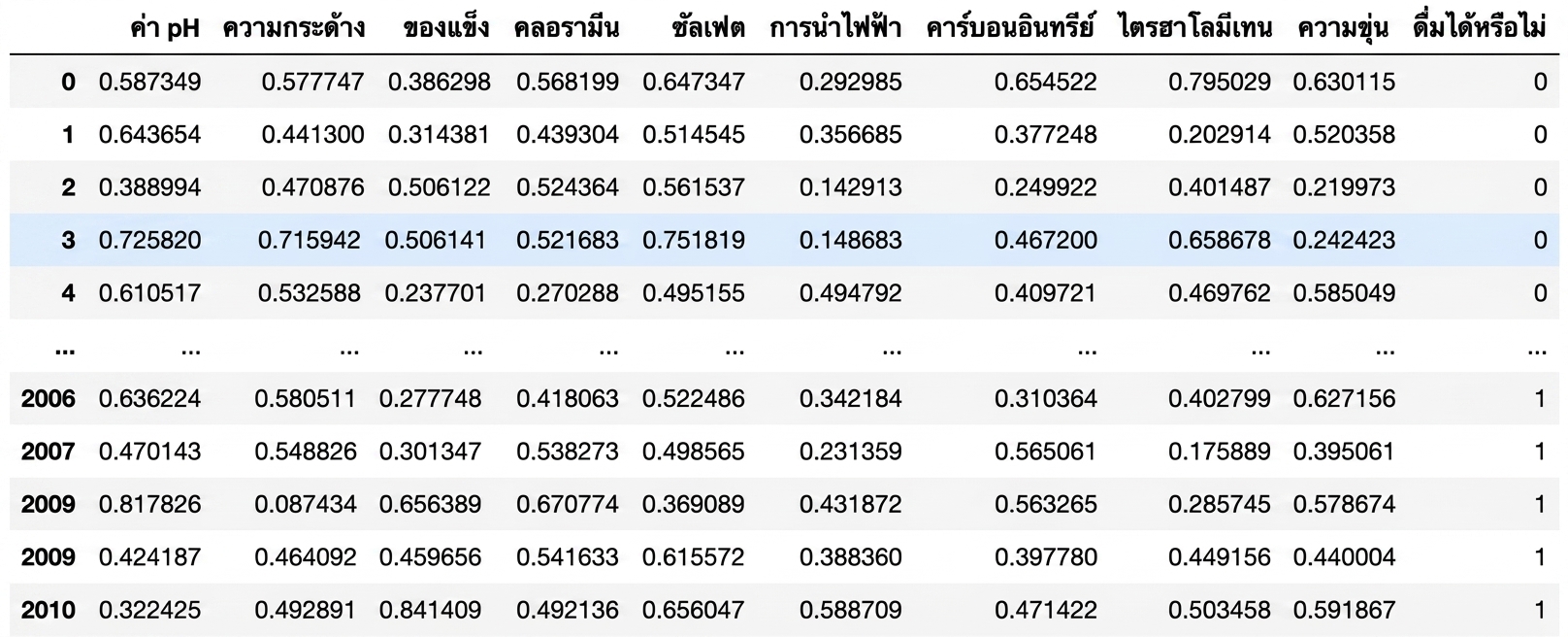
PyTorch Dataset
from torch.utils.data import Dataset class WaterDataset(Dataset):def __init__(self, csv_path): super().__init__() df = pd.read_csv(csv_path) self.data = df.to_numpy()def __len__(self): return self.data.shape[0]def __getitem__(self, idx): features = self.data[idx, :-1] label = self.data[idx, -1] return features, label
- init: โหลดข้อมูลและเก็บเป็น numpy array
super().__init__()ทำให้WaterDatasetทำงานเหมือน torchDataset
- len: คืนค่าขนาดของชุดข้อมูล
- getitem:
- รับอาร์กิวเมนต์หนึ่งตัวชื่อ
idx - คืนค่า features และ label ของตัวอย่างที่ index
idx
- รับอาร์กิวเมนต์หนึ่งตัวชื่อ
PyTorch DataLoader
dataset_train = WaterDataset(
    "water_train.csv"
)
from torch.utils.data import DataLoader

dataloader_train = DataLoader(
    dataset_train,
    batch_size=2,
    shuffle=True,
)
features, labels = next(iter(dataloader_train))
print(f"Features: {features},\nLabels: {labels}")
Features: tensor([
  [0.4899, 0.4180, 0.6299, 0.3496, 0.4575,
   0.3615, 0.3259, 0.5011, 0.7545],
  [0.7953, 0.6305, 0.4480, 0.6549, 0.7813,
   0.6566, 0.6340, 0.5493, 0.5789]
]),
Labels: tensor([1., 0.])
PyTorch Model
การกำหนดโมเดลแบบ Sequential:
net = nn.Sequential(
  nn.Linear(9, 16),
  nn.ReLU(),
  nn.Linear(16, 8),
  nn.ReLU(),
  nn.Linear(8, 1),
  nn.Sigmoid(),
)
การกำหนดโมเดลแบบ class:
class Net(nn.Module):def __init__(self): super().__init__() self.fc1 = nn.Linear(9, 16) self.fc2 = nn.Linear(16, 8) self.fc3 = nn.Linear(8, 1)def forward(self, x): x = nn.functional.relu(self.fc1(x)) x = nn.functional.relu(self.fc2(x)) x = nn.functional.sigmoid(self.fc3(x)) return x net = Net()
มาฝึกกันเถอะ!
Deep Learning ระดับกลางด้วย PyTorch

