R 中的树模型机器学习
Sandro Raabe
Data Scientist
head(chocolate, 5)
final_grade review_date   cocoa_percent  company_location  bean_type              broad_bean_origin
<dbl>       <int>         <dbl>          <fct>             <fct>                  <fct>
3           2009          0.8            U.K.              "Criollo, Trinitario"  "Madagascar"
3.75        2012          0.7            Guatemala         "Trinitario"           "Madagascar"
2.75        2009          0.75           Colombia          "Forastero (Nacional)" "Colombia"
3.5         2014          0.74           Zealand           ""                     "Papua New Guinea"
3.75        2011          0.72           Australia         ""                     "Bolivia"
spec <- decision_tree() %>%

  set_mode("regression") %>%

  set_engine("rpart")


print(spec)
spec <- decision_tree() %>%
set_mode("regression") %>%
set_engine("rpart")
print(spec)
Decision Tree Model Specification
(regression)

Computational engine: rpart
model <- spec %>%
  fit(formula = final_grade ~ .,

      data = chocolate_train)


print(model)
model <- spec %>% fit(formula = final_grade ~ .,
data = chocolate_train)
print(model)
parsnip model object

Fit time:  20ms
n= 1437

node), split, n, deviance, yval
      * denotes terminal node
# 在新数据上做预测
predict(model, new_data = chocolate_test)
.pred
<dbl>
3.281915
3.435234
3.281915
3.833931
3.281915
3.514151
3.273864
3.514151
min_n
tree_depth
cost_complexity
decision_tree(tree_depth = 4, cost_complexity = 0.05) %>%
    set_mode("regression")
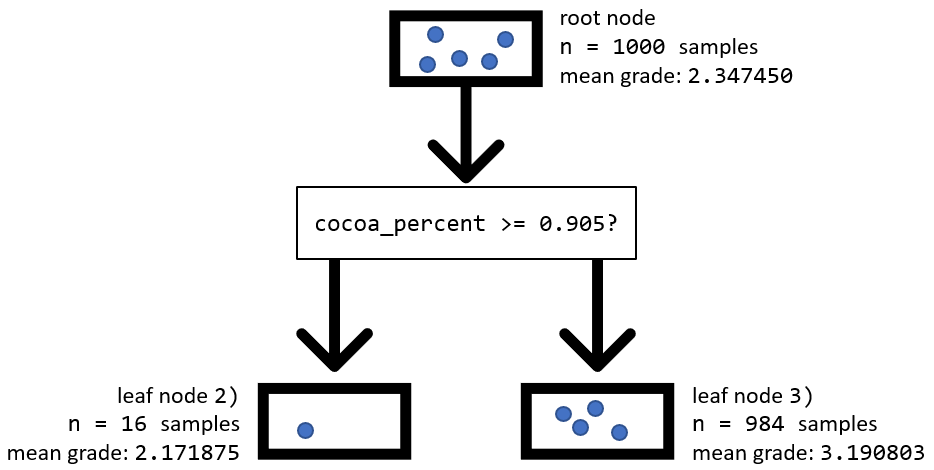
decision_tree(tree_depth = 1) %>%
  set_mode("regression") %>%
  set_engine("rpart")  %>%
  fit(formula = final_grade ~ .,
      data = chocolate_train)
parsnip model object

Fit time:  1ms
n= 1000

node), split, n, yval

1) root                 1000  2.347450
2) cocoa_percent>=0.905   16  2.171875 *
3) cocoa_percent<0.905   984  3.190803 *
tree_depth = 1