# Shift a DataFrame/Series by 3 index values towards the past
print(df.shift(3))
         df
    0   NaN
    1   NaN
    2   NaN
    3   0.0
    4   1.0
创建时移 DataFrame
# data is a pandas Series containing time series data
data = pd.Series(...)

# Shifts
shifts = [0, 1, 2, 3, 4, 5, 6, 7]

# Create a dictionary of time-shifted data
many_shifts = {'lag_{}'.format(ii): data.shift(ii) for ii in shifts}

# Convert them into a dataframe
many_shifts = pd.DataFrame(many_shifts)
用时移特征拟合模型
# Fit the model using these input features
model = Ridge()
model.fit(many_shifts, data)
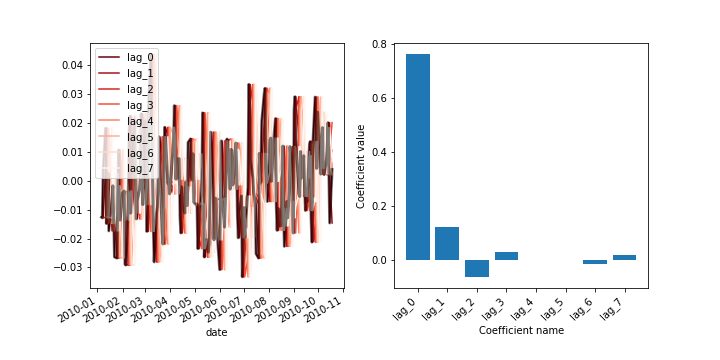
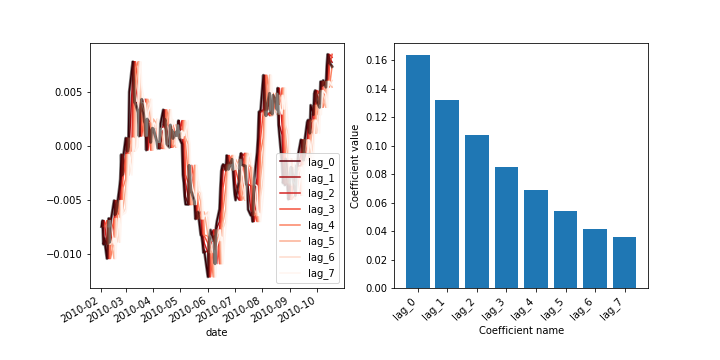
解读自回归模型系数
# Visualize the fit model coefficients
fig, ax = plt.subplots()
ax.bar(many_shifts.columns, model.coef_)
ax.set(xlabel='Coefficient name', ylabel='Coefficient value')

# Set formatting so it looks nice
plt.setp(ax.get_xticklabels(), rotation=45, horizontalalignment='right')