识别关联规则
Python 中的购物篮分析

Isaiah Hull
Visiting Associate Professor of Finance, BI Norwegian Business School
加载与准备数据
import pandas as pd

# Load transactions from pandas.
books = pd.read_csv("datasets/bookstore.csv")
# Split transaction strings into lists.
transactions = books['Transaction'].apply(lambda t: t.split(','))
# Convert DataFrame into list of strings.
transactions = list(transactions)
探索数据
print(transactions[:5])
[['language', 'travel', 'humor', 'fiction'],
 ['humor', 'language'],
 ['humor', 'biography', 'cooking'],
 ['cooking', 'language'],
 ['travel']]
关联规则
关联规则
- 包含前件与后件
- {health} $\rightarrow$ {cooking}
- 包含前件与后件
多前件规则
- {humor, travel} $\rightarrow$ {language}
多后件规则
- {biography} $\rightarrow$ {history, language}
选择规则的难点
找到有用的规则很难。
- 所有可能规则的集合很大。
- 大多规则无用。
- 必须舍弃大部分规则。
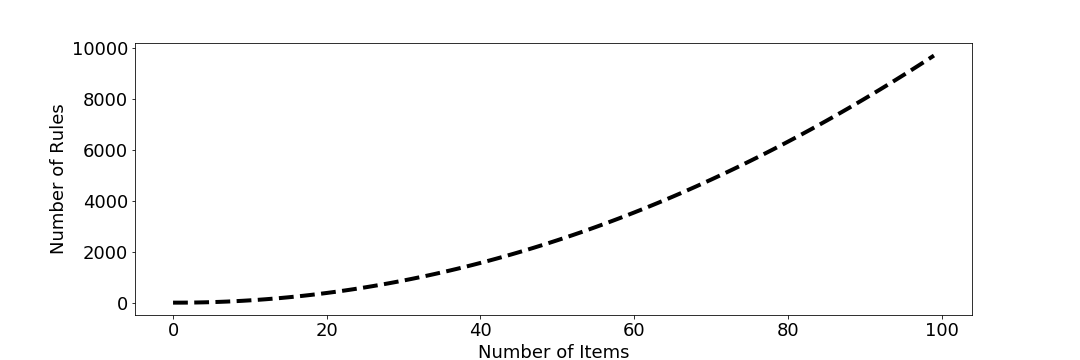
若仅限于简单规则会怎样?
- 一个前件和一个后件。
- 即使小数据集也不易。
生成规则
- fiction
- poetry
- history
- biography
- cooking
- health
- travel
- language
- humor
生成规则
| 小说 规则 | 诗歌 规则 | ... | 幽默 规则 |
|---|---|---|---|
| fiction->poetry | poetry->fiction | ... | humor->fiction |
| fiction->history | poetry->history | ... | humor->history |
| fiction->biography | poetry->biography | ... | humor->biography |
| fiction->cooking | poetry->cooking | ... | humor->cooking |
| ... | ... | ... | ... |
| fiction->humor | poetry->humor | ... |
用 itertools 生成规则
from itertools import permutations

# Extract unique items.
flattened = [item for transaction in transactions for item in transaction]
items = list(set(flattened))
# Compute and print rules.
rules = list(permutations(items, 2))
print(rules)
[('fiction', 'poetry'),
 ('fiction', 'history'),
 ...
 ('humor', 'travel'),
 ('humor', 'language')]
统计规则数量
# Print the number of rules
print(len(rules))
72
前瞻
# Import the association rules function
from mlxtend.frequent_patterns import association_rules
from mlxtend.frequent_patterns import apriori

# Compute frequent itemsets using the Apriori algorithm
frequent_itemsets = apriori(onehot, min_support = 0.001,
                            max_len = 2, use_colnames = True)

# Compute all association rules for frequent_itemsets
rules = association_rules(frequent_itemsets,
                            metric = "lift",
                            min_threshold = 1.0)
开始练习!
Python 中的购物篮分析

