MovieLens 数据集简介
使用 PySpark 构建推荐引擎

Jamen Long
Data Scientist at Nike
MovieLens 数据集
F. Maxwell Harper 和 Joseph A. Konstan,2015
The MovieLens Datasets: History and Context.
ACM Transitions on Interactive Intelligent Systems (TiiS) 5, 4,文章 19(2015 年 12 月),19 页。
DOI=http://dx.doi.org/10.1145/2827872
MovieLens 概要统计
F. Maxwell Harper 和 Joseph A. Konstan,2015
The MovieLens Datasets: History and Context.
ACM Transitions on Interactive Intelligent Systems (TiiS) 5, 4,文章 19(2015 年 12 月),19 页。
DOI=http://dx.doi.org/10.1145/2827872
评分: 20,000,000+
用户: 138,493
电影: 27,278
探索数据
df.show()
df.columns()
MovieLens 稀疏性
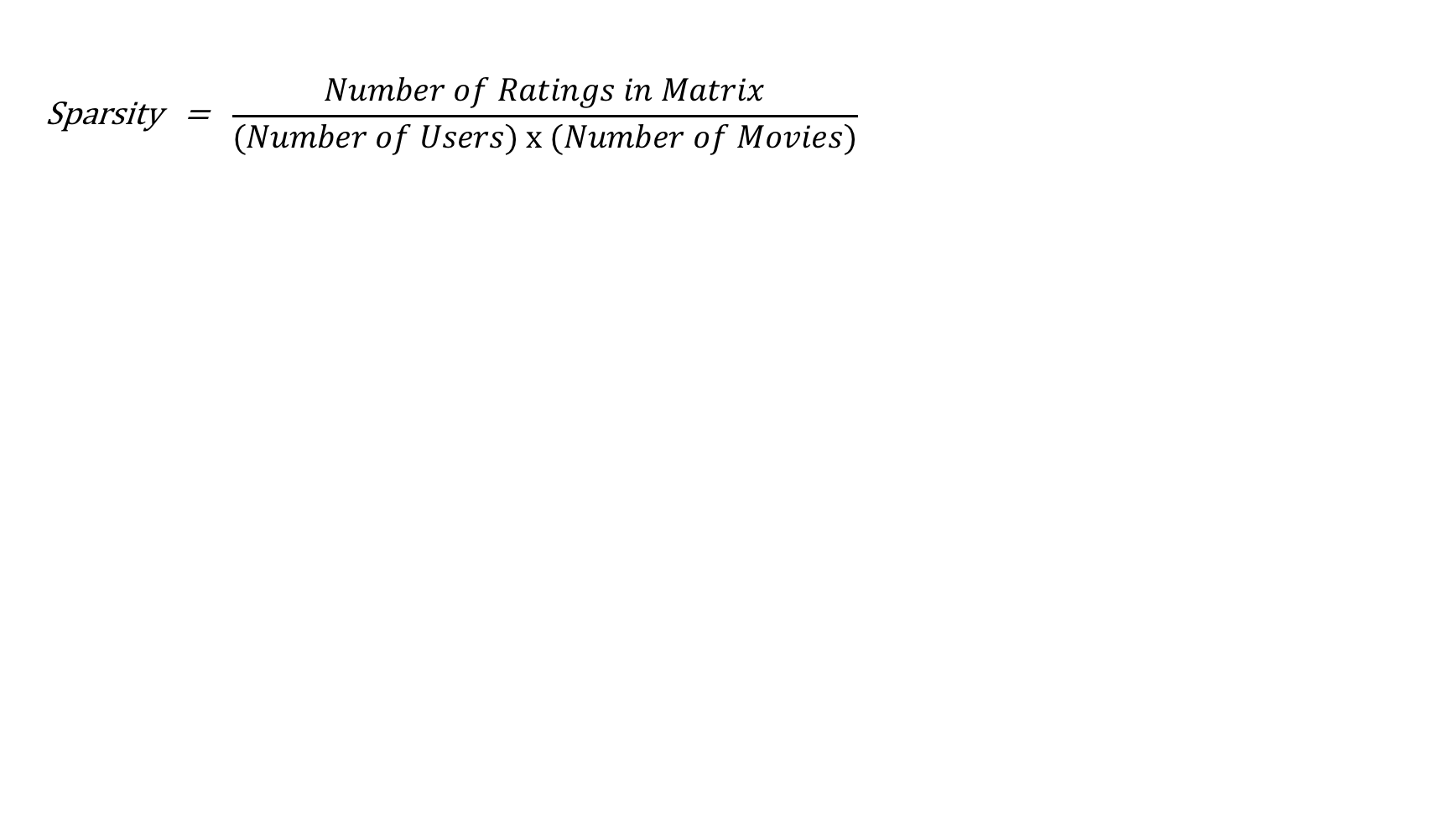
稀疏性:分子
# 矩阵中的评分数量
numerator = ratings.count()
稀疏性:用户与电影
# 唯一用户与电影数
users = ratings.select("userId").distinct().count()
movies = ratings.select("movieId").distinct().count()
稀疏性:分母
# 矩阵中的评分数量 numerator = ratings.count() # 唯一用户与电影数 users = ratings.select("userId").distinct().count() movies = ratings.select("movieId").distinct().count()# 若无空单元,矩阵可包含的评分数 denominator = users * movies
稀疏性
# 矩阵中的评分数量
numerator = ratings.count()

# 唯一用户与电影数
users = ratings.select("userId").distinct().count()
movies = ratings.select("movieId").distinct().count()

# 若无空单元,矩阵可包含的评分数
denominator = users * movies
# 计算稀疏性
sparsity = 1 - (numerator*1.0 / denominator)
print ("Sparsity: "), sparsity
Sparsity: .998
.distinct() 方法
ratings.select("userId").distinct().count()
671
GroupBy 方法
# 按 userId 分组
ratings.groupBy("userId")
GroupBy 方法
# 每位用户的播放次数
ratings.groupBy("userId").count().show()
+------+-----+
|userId|count|
+------+-----+
|   148|   76|
|   243|   12|
|    31|  232|
|   137|   16|
|   251|   19|
|    85|  752|
|    65|  737|
|   255|    9|
|    53|  190|
|   133|  302|
|   296|   74|
|    78|  301|
|   108|  136|
|   155|    3|
|   193|  174|
|   101|    1|
+------+-----+
GroupBy 方法:最小值
from pyspark.sql.functions import min, max, avg

# 每位用户的最小播放次数
msd.groupBy("userId").count()
              .select(min("count")).show()
+----------+
|min(count)|
+----------+
|         1|
+----------+
GroupBy 方法:最大值
# 每位用户的最大播放次数
ratings.groupBy("userId").count()
              .select(max("count")).show()
+----------+
|max(count)|
+----------+
|      1162|
+----------+
GroupBy 方法:平均值
# 每位用户的平均播放次数
ratings.groupBy("userId").count()
              .select(avg("count")).show()
+----------+
|avg(count)|
+----------+
| 233.34579|
+----------+
Filter 方法
# 移除少于 20 条评分的用户
ratings.groupBy("userId").count().filter(col("count") >= 20).show()
+------+-----+
|userId|count|
+------+-----+
|   148|   76|
|    31|  232|
|    85|  752|
|    65|  737|
|    53|  190|
|   133|  302|
|   296|   74|
|    78|  301|
|   108|  136|
|   193|  174|
+------+-----+
¡Vamos a practicar!
使用 PySpark 构建推荐引擎

