样本外验证与交叉验证
用 R 进行市场营销分析的机器学习

Verena Pflieger
Data Scientist at INWT Statistics
样本外拟合:训练集与测试集
1) 将数据集划分为训练集和测试集
# Generating random index for training and test set
# set.seed ensures reproducibility of random components
set.seed(534381)

churnData$isTrain <- rbinom(nrow(churnData), 1, 0.66)
train <- subset(churnData, churnData$isTrain == 1)
test <- subset(churnData, churnData$isTrain == 0)
样本外拟合:建模
2) 基于训练集建模
# Modeling logitTrainNew
logitTrainNew <- glm( returnCustomer ~ title + newsletter +
                     websiteDesign + paymentMethod + couponDiscount +
                     purchaseValue + throughAffiliate +
                     shippingFees + dvd + blueray + vinyl +
                     videogameDownload + prodOthers + prodRemitted,
                     family = binomial, data = train)

# Out-of-sample prediction for logitTrainNew
test$predNew <- predict(logitTrainNew, type = "response",
                        newdata = test)
样本外准确率
# Calculating the confusion matrix
confMatrixNew <- confusion.matrix(test$returnCustomer, test$predNew,
                 threshold = 0.3)
confMatrixNew

# Calculating the accuracy
accuracyNew <- sum(diag(confMatrixNew)) / sum(confMatrixNew)
accuracyNew
    obs
pred     0    1
   0 11939 2449
   1   716  350

0.7951987
交叉验证:设置
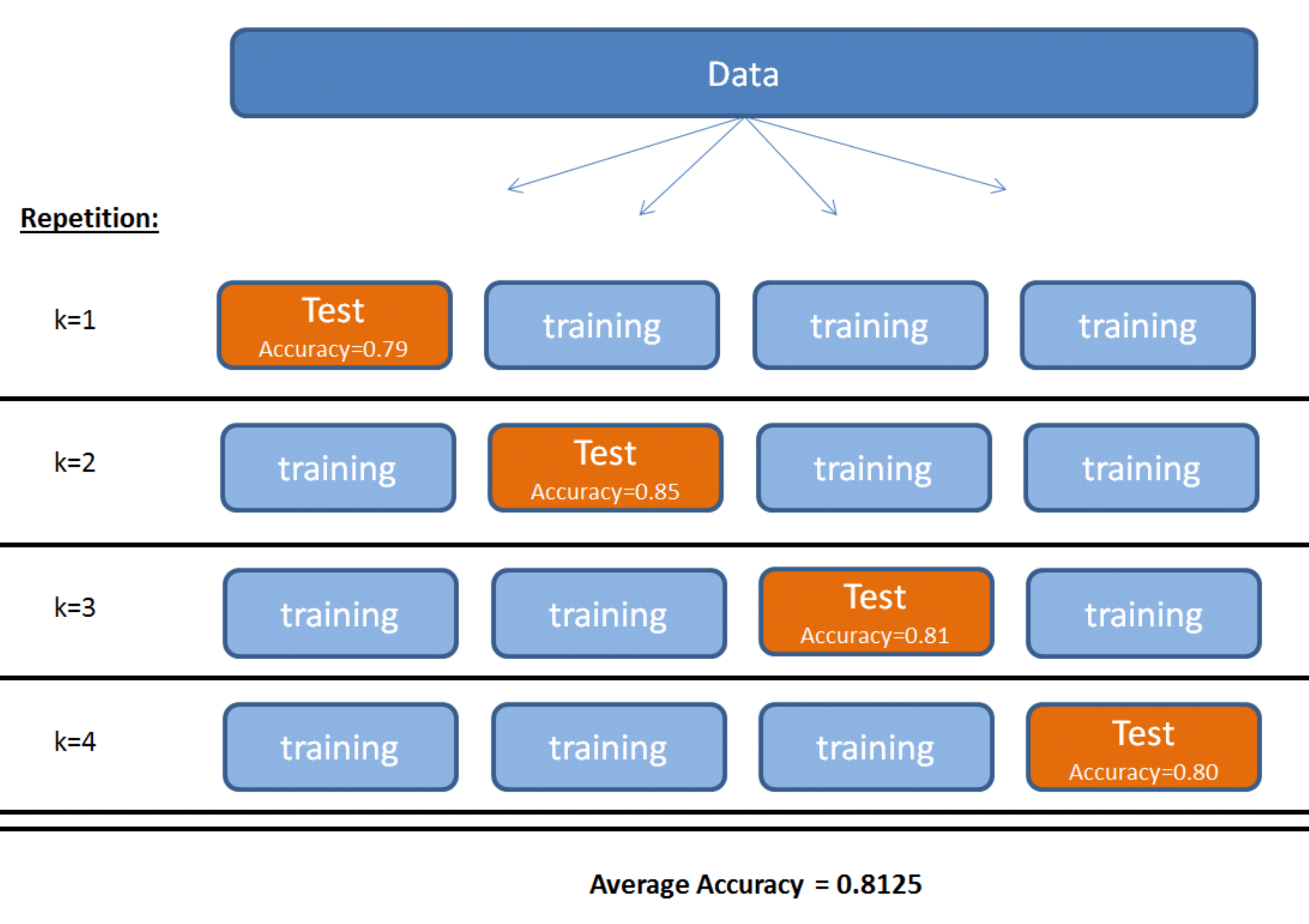
交叉验证:准确率
交叉验证准确率的计算
library(boot)
# Accuracy function with threshold = 0.3
Acc03 <- function(r, pi = 0) {
  cm <- confusion.matrix(r, pi, threshold = 0.3)
  acc <- sum(diag(cm)) / sum(cm)
  return(acc)}
# Accuracy
set.seed(534381)
cv.glm(churnData, logitModelNew, cost = Acc03, K = 6)$delta
0.7943894
| 逻辑回归要点 | |
|---|---|
| 你已学会… | 预测可能流失的网店客户 |
| 用二元逻辑回归计算概率 | |
| 阈值选择至关重要 |
| 模型洞见 | |
|---|---|
| 你已学会… | 订阅新闻简报的客户更可能回访 |
| 使用优惠券的客户回访可能性更低 | |
| 免运费的客户更可能回访 | |
| 等等… |
最后一道练习!
用 R 进行市场营销分析的机器学习

