避免不必要的复杂性
在 R 中构建 GARCH 模型

Kris Boudt
Professor of finance and econometrics
避免不必要的复杂性
- 如果你已知:
- 均值动态可忽略
- 方差中不存在杠杆效应
- 分布对称且厚尾
那么,常数均值、标准 GARCH(1,1)、Student-t 分布是合适的设定:
garchspec <- ugarchspec(mean.model = list(armaOrder = c(0, 0)),
                        variance.model = list(model = "sGARCH"),
                        distribution.model = "std")
限制参数估计
- 若你知道某些参数:
- 等于某个固定值
- 或落在某个区间内
- 则应在规格中施加:
setfixed()setbounds()
汇率应用示例
设定与估计
garchspec <- ugarchspec(mean.model = list(armaOrder = c(0, 0)),
                        variance.model = list(model = "sGARCH"),
                        distribution.model = "std")
garchfit <- ugarchfit(data = EURUSDret, spec = garchspec)
估计结果
coef(garchfit)
           mu         omega        alpha1         beta1         shape
-3.562136e-05  8.005123e-08  3.097322e-02  9.674496e-01  8.821902e+00
setfixed() 示例
- 若你知道
alpha1 = 0.05和shape = 6:在估计中固定它们。 - 如何做?对
ugarchspec对象使用setfixed()方法
setfixed(garchspec) <- list(alpha1 = 0.05, shape = 6)
结果
garchfit <- ugarchfit(data = EURUSDret, spec = garchspec)

coef(garchfit)
           mu         omega        alpha1         beta1         shape
-4.142922e-05  2.061772e-07  5.000000e-02  9.489622e-01  6.000000e+00
参数取值范围(Bounds)
- GARCH 参数可限制在一个区间内。
- 有时可行区间较大:
- 为保证方差为正,例如要求所有方差参数($\omega$、$\alpha$、$\beta$、$\gamma$)为正。
- 有时可行区间更小:
- $\alpha$ 的可能取值在 0.05 到 0.2 之间
- $\beta$ 的可能取值在 0.7 到 0.95 之间
- 可用
setbounds()方法对参数施加此类界约束。
setbounds() 示例
setbounds(garchspec) <- list(alpha1 = c(0.05, 0.2), beta1 = c(0.8, 0.95))
用直觉避免不必要的复杂性。
利用已有信息:
- 构建简单(且聪明)的模型
- 固定参数或设定取值范围
让 GARCH 动态更贴近现实:
- 波动率围绕样本标准差的均值回归
sd(EURUSDret) # returns a value of 0.006194049
- 波动率围绕样本标准差的均值回归
波动簇与波动率的均值回归
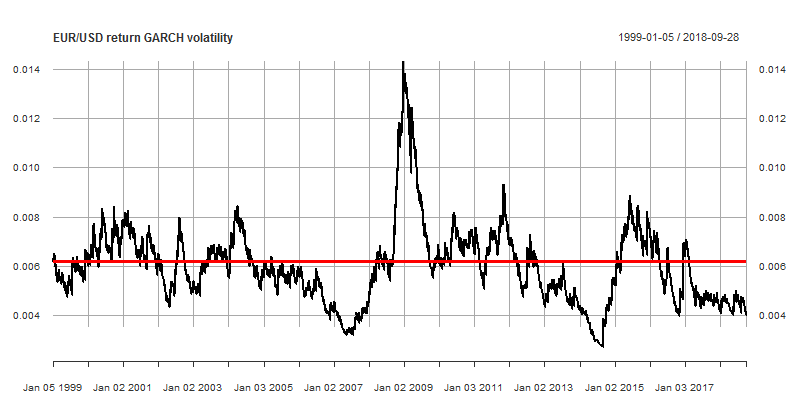
方差瞄准(variance targeting)
- 数学上,这意味着 GARCH 模型蕴含的无条件方差等于样本方差 $\hat \sigma^2$。
- 如何实现?在
ugarchspec()的variance.model中将参数variance.targeting = TRUE:
garchspec <- ugarchspec(mean.model = list(armaOrder = c(0,0)),
                        variance.model = list(model = "sGARCH",
                        variance.targeting = TRUE),
                        distribution.model = "std")
garchfit <- ugarchfit(data = EURUSDret, spec = garchspec)
all.equal(uncvariance(garchfit), sd(EURUSDret) ^ 2, tol = 1e-4)
TRUE
对 GARCH 模型施加约束
在 R 中构建 GARCH 模型

