Cum să utilizați date și ore cu pandas
Manipularea datelor de tip serie de timp în Python

Stefan Jansen
Founder & Lead Data Scientist at Applied Artificial Intelligence
Funcționalități pentru serii de date și ore
- La bază: tipuri de date pentru informații de dată și oră
- Obiecte pentru momente și perioade de timp
- Atributele și metodele reflectă detalii temporale
- Secvențe de date și perioade:
- Coloane Series sau DataFrame
- Index: transformă obiectul într-o serie de timp
- Multe metode Series/DataFrame utilizează informațiile temporale din index pentru funcționalități de serii de timp
Bloc de bază: pd.Timestamp
import pandas as pd # assumed imported going forward from datetime import datetime # To manually create datestime_stamp = pd.Timestamp(datetime(2017, 1, 1))pd.Timestamp('2017-01-01') == time_stamp
True # Understands dates as strings
time_stamp # type: pandas.tslib.Timestamp
Timestamp('2017-01-01 00:00:00')
Bloc de bază: pd.Timestamp
- Obiectul Timestamp are numeroase atribute pentru informații temporale
time_stamp.year
2017
time_stamp.day_name()
'Sunday'
Mai multe blocuri: pd.Period & freq
period = pd.Period('2017-01')period # default: month-end
Period('2017-01', 'M')
period.asfreq('D') # convert to daily
Period('2017-01-31', 'D')
period.to_timestamp().to_period('M')
Period('2017-01', 'M')
- Obiectul Period are atributul freq pentru informații de frecvență
- Conversia
pd.Period()înpd.Timestamp()și invers
Mai multe blocuri: pd.Period & freq
period + 2
Period('2017-03', 'M')
pd.Timestamp('2017-01-31', 'M') + 1
Timestamp('2017-02-28 00:00:00', freq='M')
- Informațiile de frecvență permit aritmetică de bază cu date
Secvențe de date și ore
pd.date_range:start,end,periods,freq
index = pd.date_range(start='2017-1-1', periods=12, freq='M')
index
DatetimeIndex(['2017-01-31', '2017-02-28', '2017-03-31', ...,
               '2017-09-30', '2017-10-31', '2017-11-30', '2017-12-31'],
              dtype='datetime64[ns]', freq='M')
pd.DateTimeIndex: secvență de obiecte Timestamp cu informații de frecvență
Secvențe de date și ore
index[0]
Timestamp('2017-01-31 00:00:00', freq='M')
index.to_period()
PeriodIndex(['2017-01', '2017-02', '2017-03', '2017-04', ...,
             '2017-11', '2017-12'], dtype='period[M]', freq='M')
Crearea unei serii de timp: pd.DateTimeIndex
pd.DataFrame({'data': index}).info()
RangeIndex: 12 entries, 0 to 11
Data columns (total 1 columns):
data    12 non-null datetime64[ns]
dtypes: datetime64[ns](1)
Crearea unei serii de timp: pd.DateTimeIndex
np.random.random:- Numere aleatoare:
[0,1] - 12 rânduri, 2 coloane
- Numere aleatoare:
data = np.random.random((size=12,2))pd.DataFrame(data=data, index=index).info()
DatetimeIndex: 12 entries, 2017-01-31 to 2017-12-31
Freq: M
Data columns (total 2 columns):
0    12 non-null float64
1    12 non-null float64
dtypes: float64(2)
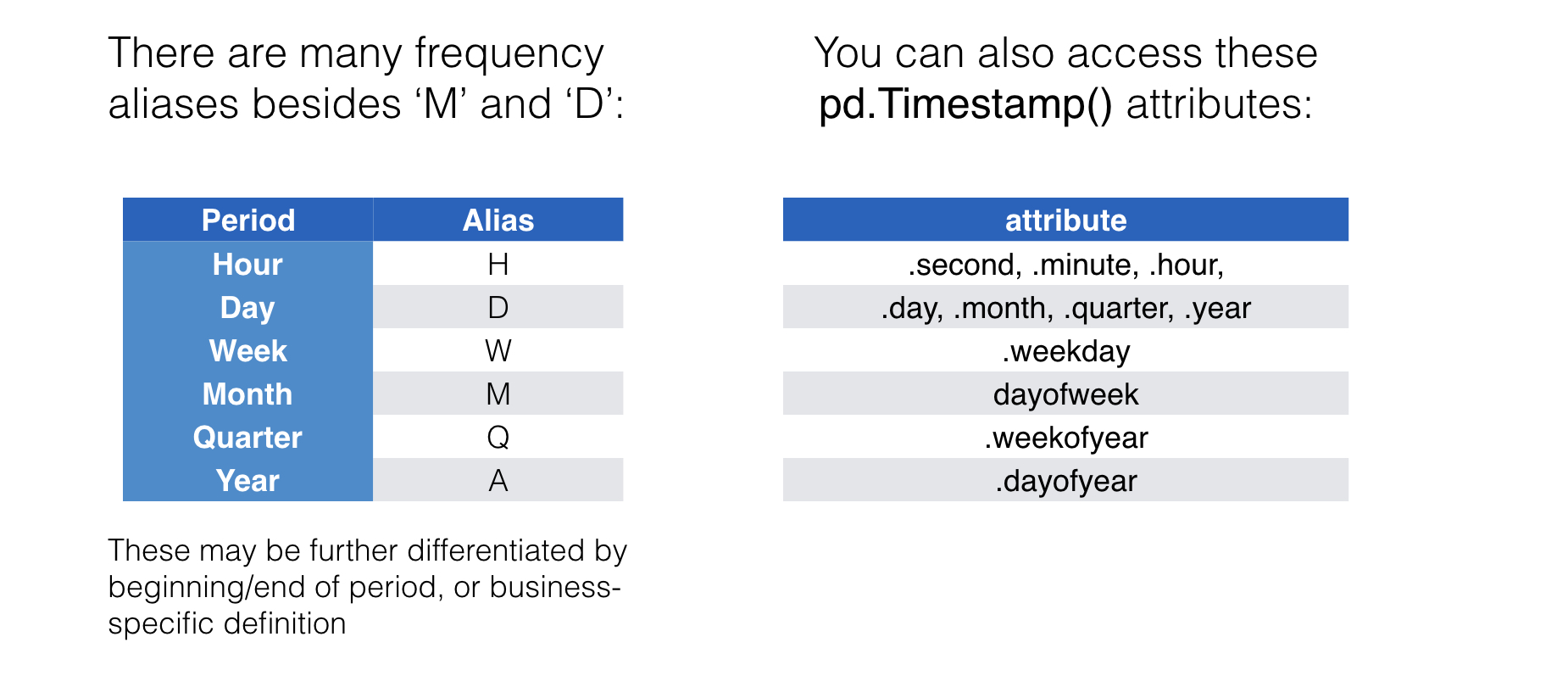
Aliasuri de frecvență și informații temporale
Să exersăm!
Manipularea datelor de tip serie de timp în Python

