Ingineria caracteristicilor în R
Jorge Zazueta
Research Professor and Head of the Modeling Group at the School of Economics, UASLP
Se atribuie un număr de index fiecărei companii aeriene pe baza valorilor text.
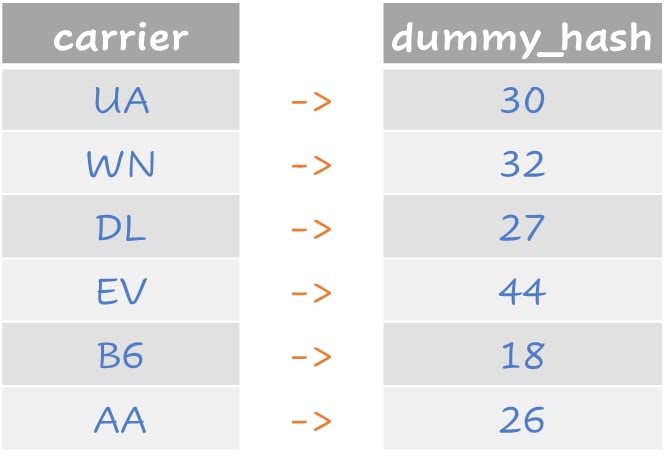
Setul de date flights include companii aeriene ca factori, dar nu știm dacă vor apărea companii noi în datele viitoare.
flights %>%
select(carrier) %>%
table()
carrier
9E AA AS B6 DL EV F9 FL HA MQ OO UA US VX WN YV
859 1744 26 2503 2619 3014 38 186 14 1540 2 3367 1228 244 757 41
Putem crea hash-uri dummy pentru a reprezenta valorile factorilor, folosind pachetul textrecipes.
recipe <- recipe(~carrier,
data = flights_train) %>%
step_dummy_hash(carrier, prefix = NULL,
signed = FALSE,
num_terms = 50L)
# Prep the recipe
object <- recipe %>%
prep()
# Bake the recipe object with new data
baked <- bake(object,
new_data = flights_test)
O privire asupra reprezentării step_dummy_hash().
bind_cols(flights_test$carrier,baked)[1:6,c(1,18:20)]
New names:
• `` -> `...1`
# A tibble: 10 × 4
...1 `_carrier_17` `_carrier_18` `_carrier_19`
<chr> <int> <int> <int>
1 EV 0 0 0
2 B6 0 1 0
3 EV 0 0 0
4 MQ 0 0 0
5 DL 0 0 0
6 EV 0 0 0
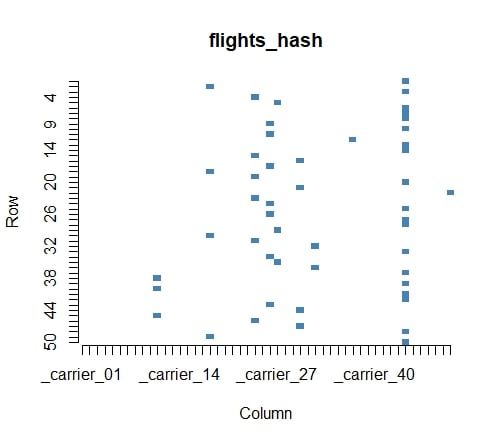
Putem vizualiza matricea cu ajutorul pachetului plot.matrix.
flights_hash <-
as.matrix(baked)[1:50,]
plot(flights_hash,
col = c("white","steelblue"),
key = NULL,
border = NA)

Ingineria caracteristicilor în R