Introduction à MLflow
Weston Bassler
Senior MLOps Engineer
Enregistrer
Consigner
Charger
# Save a model to the local filesystem
mlflow.sklearn.save_model(model, path)
# Log a model as an artifact to MLflow Tracking.
mlflow.sklearn.log_model(model, artifact_path)
# Load a model from local filesystem or from MLflow Tracking.
mlflow.sklearn.load_model(model_uri)
Système de fichiers local — relative/path/to/local/model ou /Users/me/path/to/local/model
relative/path/to/local/model
/Users/me/path/to/local/model
Suivi MLflow — runs:/<mlflow_run_id>/run-relative/path/to/model
runs:/<mlflow_run_id>/run-relative/path/to/model
Prise en charge S3 — s3://my_bucket/path/to/model
s3://my_bucket/path/to/model
# Model
lr = LogisticRegression()
lr.fit(X, y)


# Save model locall
mlflow.sklearn.save_model(lr, "local_path")
# Model lr = LogisticRegression() lr.fit(X, y)
# Save model locall mlflow.sklearn.save_model(lr, "local_path")
ls local_path/
MLmodel model.pkl requirements.txt python_env.yaml
# Load model from local path
model = mlflow.sklearn.load_model("local_path")


# Show model
model
# Load model from local path model = mlflow.sklearn.load_model("local_path")
# Show model model
LogisticRegression()
# Model
lr = LogisticRegression(n_jobs=n_jobs)
lr.fit(X, y)


# Log model
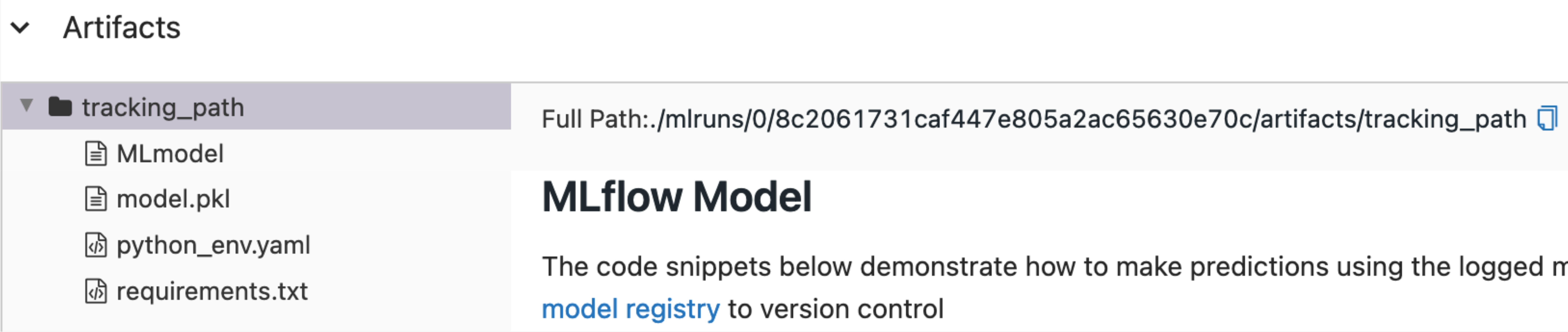
mlflow.sklearn.log_model(lr, "tracking_path")
# Model lr = LogisticRegression(n_jobs=n_jobs) lr.fit(X, y)
# Log model mlflow.sklearn.log_model(lr, "tracking_path")
# Format for runs
runs:/<mlflow_run_id>/run-relative/path/to/model
# Get last active run
run = mlflow.last_active_run()

run
# Get last active run run = mlflow.last_active_run()
run
<Run: data=<RunData: metrics={}, params={},
tags={'mlflow.runName': 'run_name'}>,
 info=<RunInfo: artifact_uri='uri', end_time='end_time',
 experiment_id='0', lifecycle_stage='active', run_id='run_id',
 run_name='name', run_uuid='run_uuid', start_time=start_time,
 status='FINISHED', user_id='user_id'>>
# Show run_id of last run run.info.run_id
'8c2061731caf447e805a2ac65630e70c'
# Get last active run
run = mlflow.last_active_run()
# Set run_id variable run_id = run.info.run_id run_id
# Set run_id variable run_id = run.info.run_id
run_id
# Pass run_id as f-string literal
model = mlflow.sklearn.load_model(f"runs:/{run_id}/tracking_path")

# Show model
model
# Pass run_id as f-string literal model = mlflow.sklearn.load_model(f"runs:/{run_id}/tracking_path")