Analyse de sentiment en Python
Violeta Misheva
Data Scientist
Décrit la présence de mots dans un document ou un corpus
Crée un vocabulaire et une mesure de leur présence
This is the best book ever. I loved the book and highly recommend it!!!
{'This': 1, 'is': 1, 'the': 2 , 'best': 1 , 'book': 2,
'ever': 1, 'I':1 , 'loved':1 , 'and': 1  , 'highly': 1,
'recommend': 1 , 'it': 1 }
import pandas as pd
from sklearn.feature_extraction.text import CountVectorizer
vect = CountVectorizer(max_features=1000)
vect.fit(data.review)
X = vect.transform(data.review)
X
<10000x1000 sparse matrix of type '<class 'numpy.int64'>'
  with 406668 stored elements in Compressed Sparse Row format>
# Transform to an array
my_array = X.toarray()
# Transform back to a DataFrame, assign column names
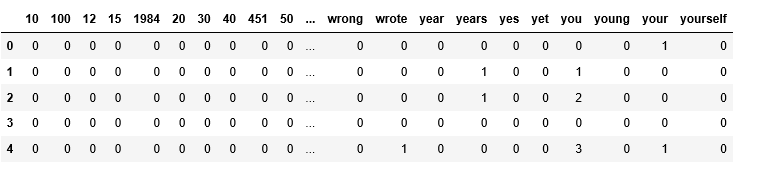
X_df = pd.DataFrame(my_array, columns=vect.get_feature_names())