Évitez la complexité inutile
Modèles GARCH en R

Kris Boudt
Professor of finance and econometrics
Évitez la complexité superflue
- Si vous savez
- que la dynamique de la moyenne est négligeable
- qu'il n'y a pas d'effet d'asymétrie (leverage) dans la variance
- que la distribution est symétrique à queues épaisses
Alors une moyenne constante, un GARCH(1, 1) standard avec une loi t de Student convient :
garchspec <- ugarchspec(mean.model = list(armaOrder = c(0, 0)),
                        variance.model = list(model = "sGARCH"),
                        distribution.model = "std")
Restreindre l'estimation des paramètres
- Si vous savez que des paramètres
- sont égaux à une certaine valeur
- ou se trouvent dans un intervalle
- Alors imposez-le dans la spécification avec
setfixed()setbounds()
Application aux taux de change
Spécification et estimation
garchspec <- ugarchspec(mean.model = list(armaOrder = c(0, 0)),
                        variance.model = list(model = "sGARCH"),
                        distribution.model = "std")
garchfit <- ugarchfit(data = EURUSDret, spec = garchspec)
Résultats d'estimation
coef(garchfit)
           mu         omega        alpha1         beta1         shape
-3.562136e-05  8.005123e-08  3.097322e-02  9.674496e-01  8.821902e+00
Exemple de setfixed()
- Si vous savez que
alpha1 = 0.05etshape = 6: imposez ces valeurs à l'estimation. - Comment ? Utilisez la méthode
setfixed()sur un objetugarchspec
setfixed(garchspec) <- list(alpha1 = 0.05, shape = 6)
Résultat
garchfit <- ugarchfit(data = EURUSDret, spec = garchspec)

coef(garchfit)
           mu         omega        alpha1         beta1         shape
-4.142922e-05  2.061772e-07  5.000000e-02  9.489622e-01  6.000000e+00
Bornes sur les paramètres
- Les paramètres GARCH peuvent être bornés à un intervalle.
- Parfois, l'intervalle plausible est large :
- Pour assurer une variance positive, on exige p. ex. que tous les paramètres de variance ($\omega$, $\alpha$, $\beta$, $\gamma$) soient positifs.
- Parfois, l'intervalle plausible est plus étroit :
- Valeurs probables de $\alpha$ entre 0,05 et 0,2
- Valeurs probables de $\beta$ entre 0,7 et 0,95
- De telles contraintes de bornes peuvent être imposées avec la méthode
setbounds().
Exemple de setbounds()
setbounds(garchspec) <- list(alpha1 = c(0.05, 0.2), beta1 = c(0.8, 0.95))
Servez-vous de votre intuition pour éviter la complexité superflue.
Exploitez l'information dont vous disposez :
- pour bâtir des modèles simples (et judicieux)
- pour fixer des valeurs ou définir des bornes
pour rendre la dynamique GARCH réaliste :
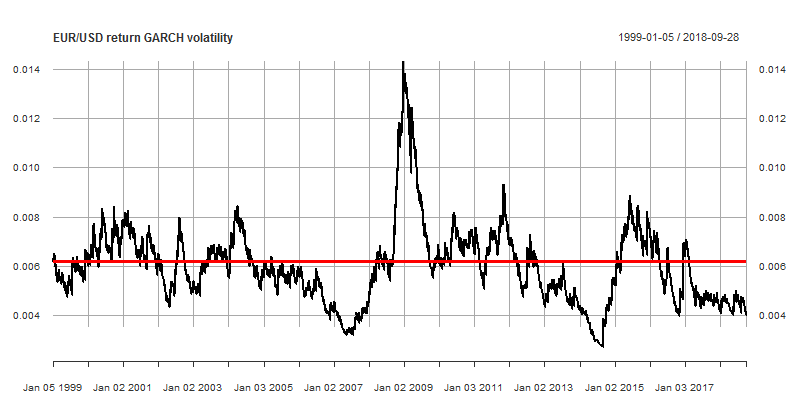
- retour à la moyenne de la volatilité autour de l'écart-type de l'échantillon
sd(EURUSDret) # retourne une valeur de 0.006194049
- retour à la moyenne de la volatilité autour de l'écart-type de l'échantillon
Amas de volatilité et retour à la moyenne de la volatilité
Ciblage de la variance
- Mathématiquement, cela signifie que la variance inconditionnelle implicite des modèles GARCH égale la variance d'échantillon $\hat \sigma^2$.
- Comment ? En définissant l'argument
variance.targeting = TRUEdansvariance.modeldeugarchspec():
garchspec <- ugarchspec(mean.model = list(armaOrder = c(0,0)),
                        variance.model = list(model = "sGARCH",
                        variance.targeting = TRUE),
                        distribution.model = "std")
garchfit <- ugarchfit(data = EURUSDret, spec = garchspec)
all.equal(uncvariance(garchfit), sd(EURUSDret) ^ 2, tol = 1e-4)
TRUE
Imposons des contraintes au modèle GARCH
Modèles GARCH en R

