Introduction au repérage de sujets

Introduction au traitement automatique des langues en R

Kasey Jones

Research Data Scientist

Repérage de sujets

Histoires de sports :

  • pointages
  • potins de joueurs
  • nouvelles d'équipe
  • etc.

Météo en Zambie :

  • ?
  • ?
Introduction au traitement automatique des langues en R

Latent Dirichlet Allocation

  1. Les documents sont des mélanges de sujets
    • Nouvelles d'équipe 70 %
    • Potins de joueurs 30 %
  2. Les sujets sont des mélanges de mots
    • Nouvelles d'équipe : trade, pitcher, move, new
    • Potins de joueurs : angry, change, money

Les journaux regorgent d'articles centrés sur des sujets précis.

1 https://en.wikipedia.org/wiki/Latent_Dirichlet_allocation
Introduction au traitement automatique des langues en R

Préparer LDA

Préparation des occurrences :

animal_farm_tokens <- animal_farm %>%
  unnest_tokens(output = "word", token = "words", input = text_column) %>%
  anti_join(stop_words) %>%
  mutate(word = wordStem(word))

Matrice documents-termes :

animal_farm_matrix <- animal_farm_tokens %>%
  count(chapter, word) %>%
  cast_dtm(document = chapter, term = word,
           value = n, weighting = tm::weightTf)
Introduction au traitement automatique des langues en R

LDA

library(topicmodels)
animal_farm_lda <- LDA(train, k = 4, method = 'Gibbs',
                 control = list(seed = 1111))
animal_farm_lda
Un modèle de sujets LDA_Gibbs avec 4 sujets.
Introduction au traitement automatique des langues en R

Résultats LDA

animal_farm_betas <-
    tidy(animal_farm_lda, matrix = "beta")
animal_farm_betas
# A tibble: 11,004 x 3
   topic term         beta
   <int> <chr>       <dbl>
...
 5     1 abolish 0.0000360
 6     2 abolish 0.00129  
 7     3 abolish 0.000355 
 8     4 abolish 0.0000381
...
sum(animal_farm_betas$beta)
[1] 4
Introduction au traitement automatique des langues en R

Mots clés par sujet

animal_farm_betas %>%
  group_by(topic) %>%
  slice_max(beta, n = 10) %>%
  arrange(topic, -beta) %>%
  filter(topic == 1)
   topic term          beta
   <int> <chr>        <dbl>
 1     1 napoleon   0.0339 
 2     1 anim       0.0317 
 3     1 windmil    0.0144 
 4     1 squealer   0.0119 
 ...
animal_farm_betas %>%
  group_by(topic) %>%
  slice_max(beta, n = 10) %>%
  arrange(topic, -beta) %>%
  filter(topic == 2)
   topic term        beta
   <int> <chr>      <dbl>
...
 3     2 anim     0.0189 
 ...
 6     2 napoleon 0.0148 
 ...
Introduction au traitement automatique des langues en R

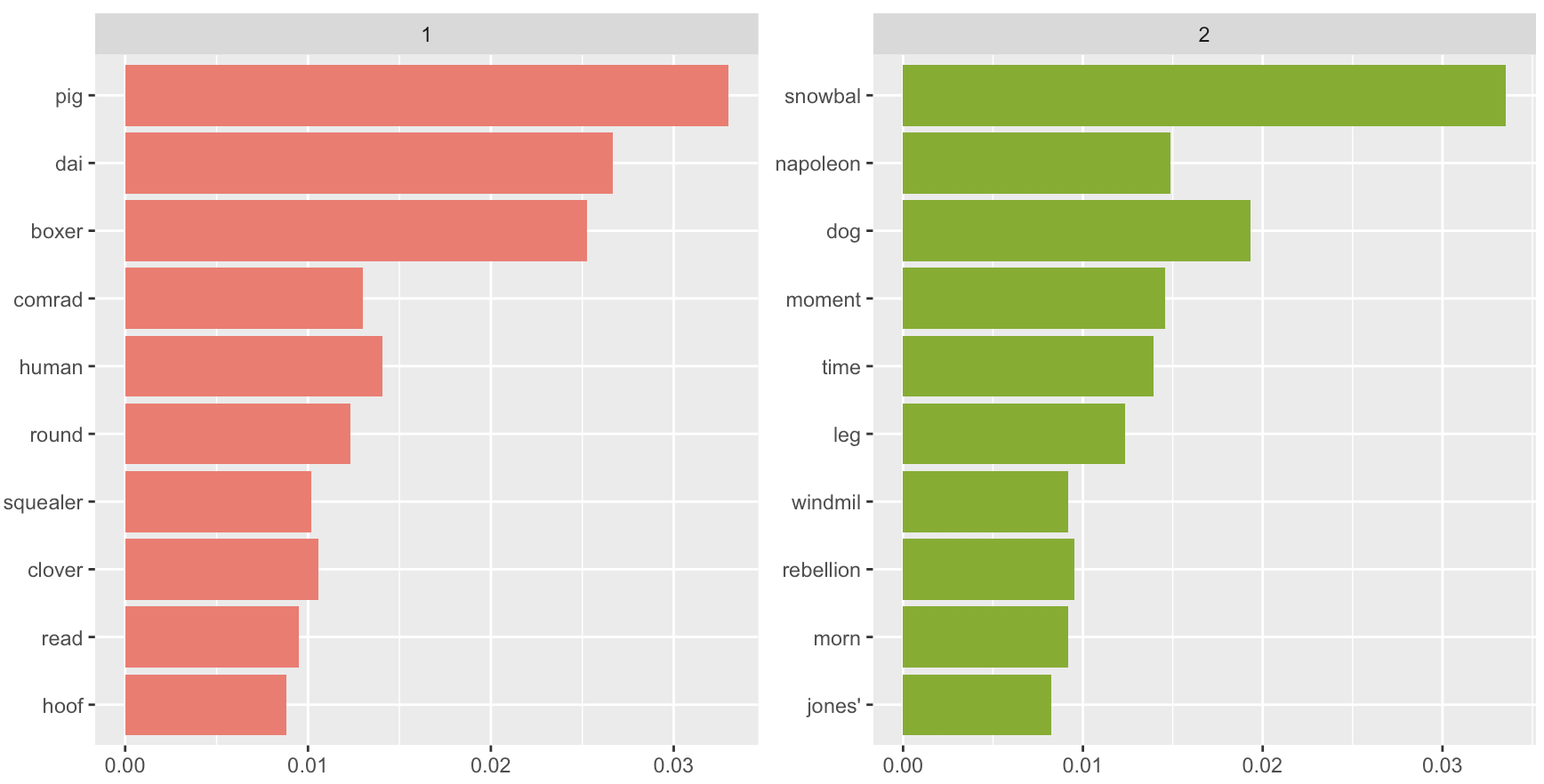
Mots clés : suite

On peut lister les mots clés par sujet et les visualiser avec ggplot.

1 https://www.tidytextmining.com/topicmodeling.html
Introduction au traitement automatique des langues en R

Attribuer des sujets aux documents

animal_farm_chapters <- tidy(animal_farm_lda, matrix = "gamma")
animal_farm_chapters %>%
  filter(document == 'Chapter 1')
# A tibble: 4 x 3
  document  topic  gamma
  <chr>     <int>  <dbl>
1 Chapter 1     1 0.157 
2 Chapter 1     2 0.136 
3 Chapter 1     3 0.623 
4 Chapter 1     4 0.0838
Introduction au traitement automatique des langues en R

Passons à la pratique !

Introduction au traitement automatique des langues en R

Preparing Video For Download...