Opérations glissantes

Optimiser le code R avec Rcpp

Romain François

Consulting Datactive, ThinkR

Moyennes glissantes
rollmean1 <- function(x, window = 3){
  n <- length(x)

  # create empty vector full of NA
  res <- rep(NA, n)

  # fill the values
  for( i in seq(window, n) ){
    idx <- seq(i-window+1,i)
    res[i] <- mean(x[idx])
  }
  res
}
Optimiser le code R avec Rcpp

Moyennes glissantes

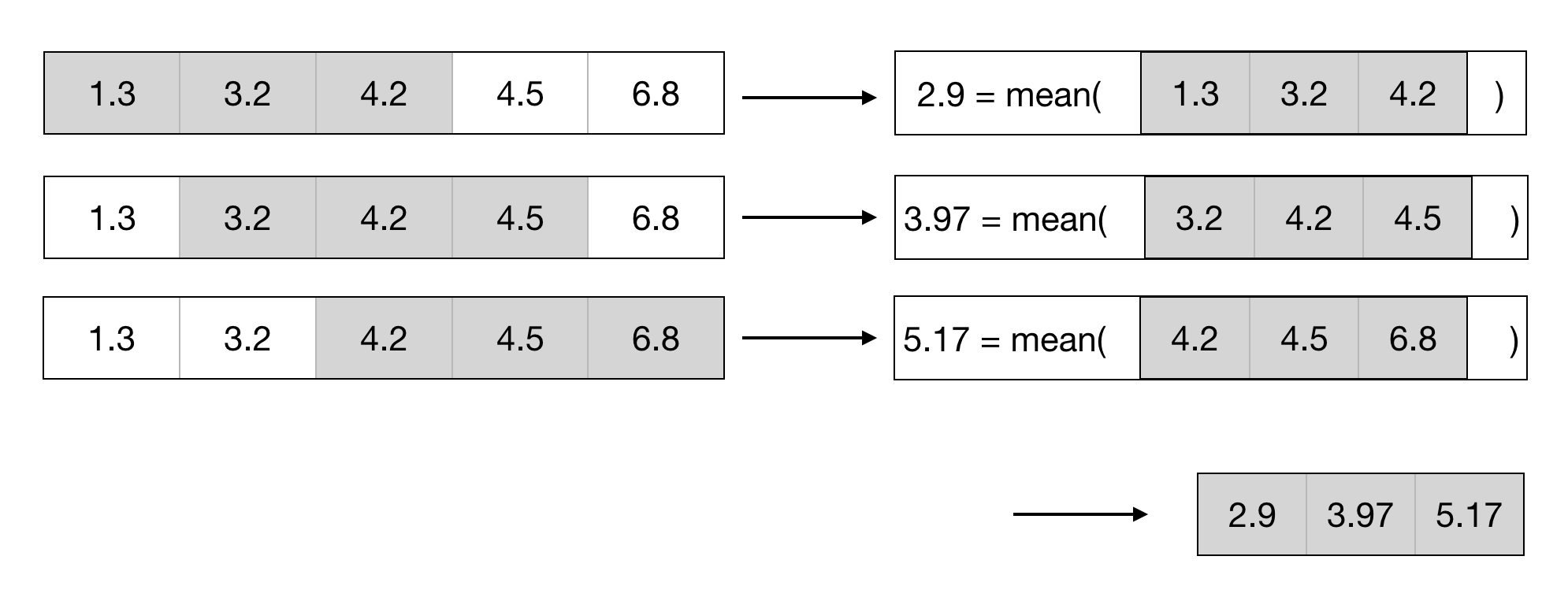
  • Créer un vecteur d'entiers pour les indices, extraire la partie pertinente de x
  • Appeler la fonction mean sur cet extrait
Optimiser le code R avec Rcpp

Algorithme alternatif

Optimiser le code R avec Rcpp

Algorithme alternatif

rollmean2 <- function(x, window = 3){
  n <- length(x)
  res <- rep(NA, n)

  # first value
  total <- sum(head(x,window))
  res[window] <- total / window

  # remaining values
  for( i in seq(window+1, n) ){
    total <- total + x[i] - x[i-window]
    res[i] <- total / window
  }
  res
}
Optimiser le code R avec Rcpp

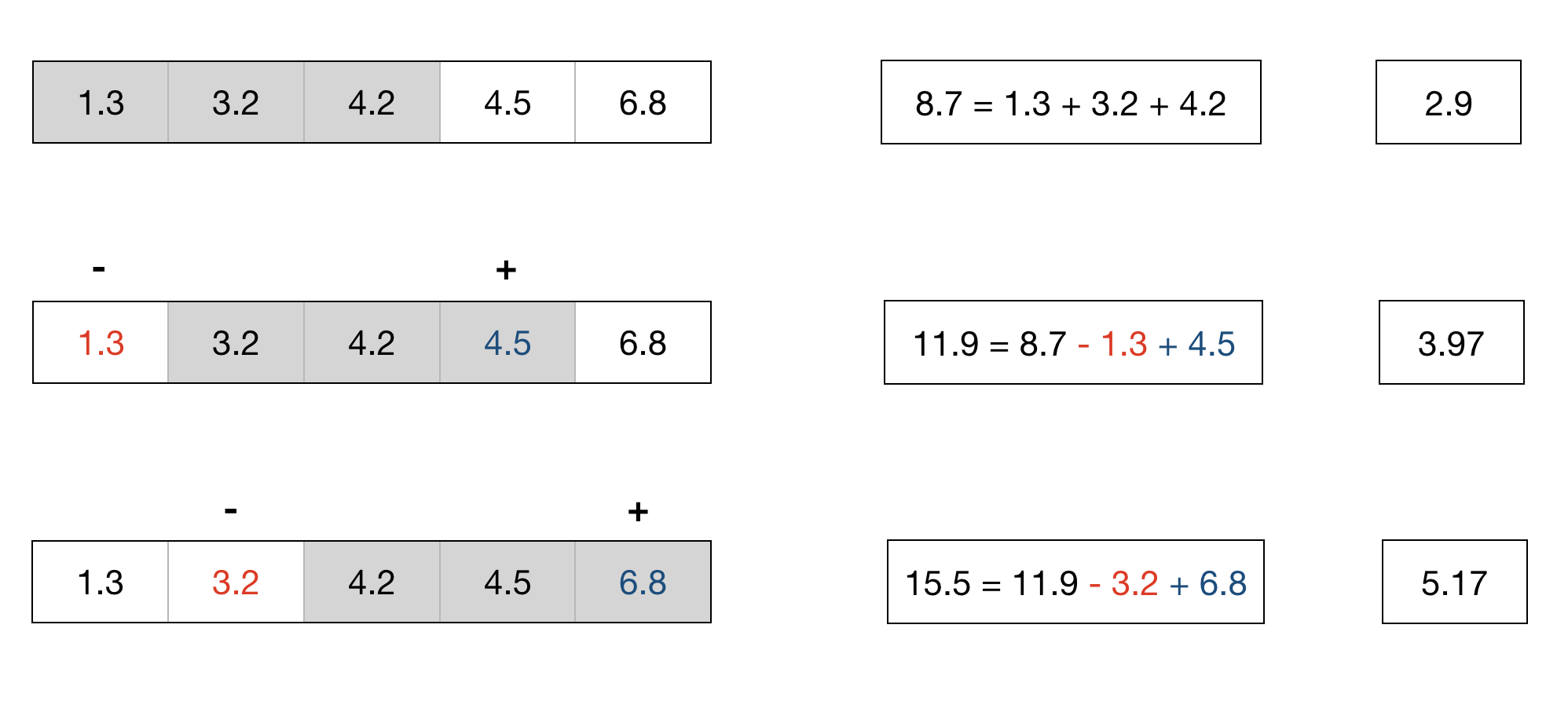
Vectorisation « hackstucieuse » (hack + astucieux)

x <- c(1.3, 3.2, 4.2, 4.5, 6.8)
start <- sum(x[1:3])
head( x, -3 )
tail( x, -3 )
1.3 3.2

4.5 6.8
c( start, start + cumsum( tail(x, -3) - head( x, -3 ) ) )

c( start, start + cumsum( tail(x, -3) - head( x, -3 ) ) ) / 3
8.7 11.9 15.5

2.900000 3.966667 5.166667
Optimiser le code R avec Rcpp

Comparaison

library(microbenchmark)
x <- rnorm(1e5)

microbenchmark(
    rollmean1(x, 3), 
    rollmean2(x, 3), 
    rollmean3(x, 3)
)
Unit: milliseconds
            expr        min         lq       mean     median ...
 rollmean1(x, 3) 833.667884 857.507753 971.250098 893.206776 ...
 rollmean2(x, 3)  10.539993  11.034244  12.293105  11.396629 ...
 rollmean3(x, 3)   1.429817   1.625453   3.070925   3.067068 ...
Optimiser le code R avec Rcpp

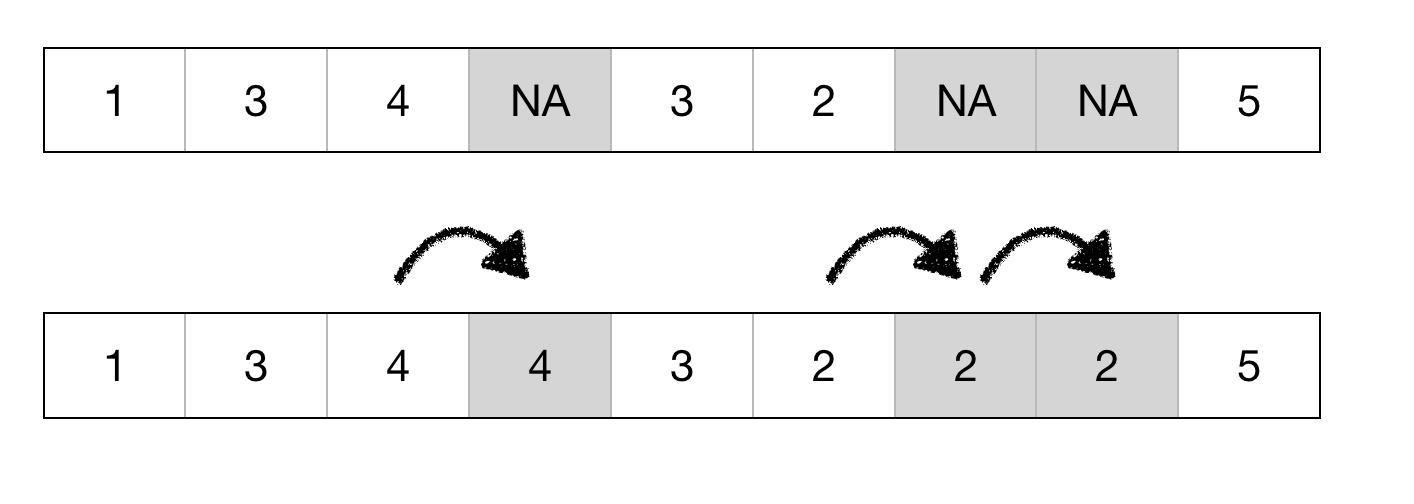
Dernière observation reportée

Optimiser le code R avec Rcpp

Dernière observation reportée

na_locf1 <- function(x){
  current <- NA

  res <- x
  for( i in seq_along(x)){
    if( is.na(x[i]) ){
      # replace with current
      res[i] <- current
    } else {
      # set current 
      current <- x[i]
    }
  }  
  res
}
Optimiser le code R avec Rcpp

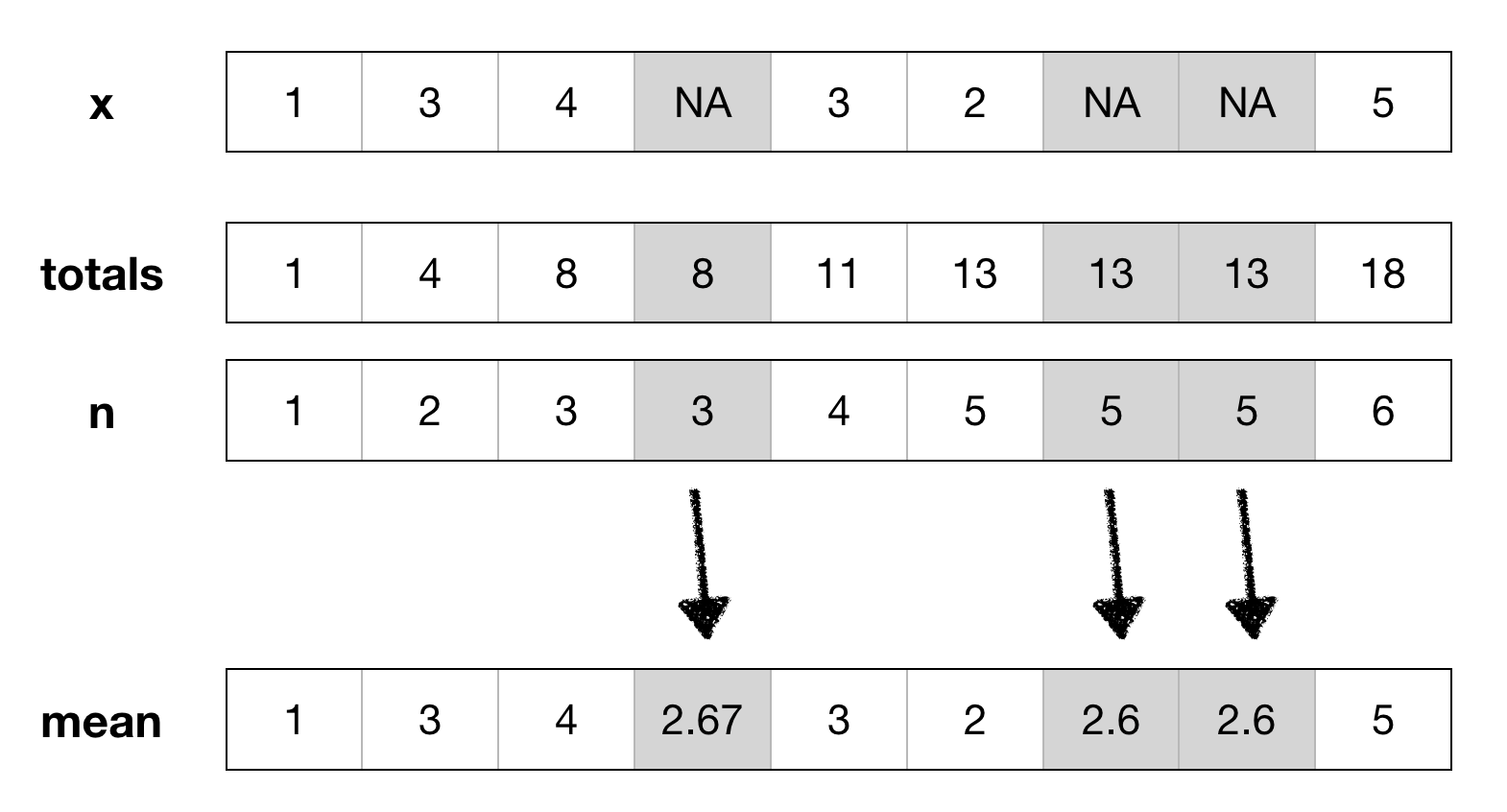
Moyenne reportée

Optimiser le code R avec Rcpp
na_meancf1 <- function(x){
  # ( cumulative sum of non NA values ) / ( cumulative count of non NA )
  means <- cumsum( replace(x, is.na(x), 0) ) / cumsum(!is.na(x))  
  # replace the missing values by the means
  x[is.na(x)] <- means[is.na(x)]
  x    }

# iterative version
na_meancf2 <- function(x){
  total <- 0
  n     <- 0
  for( i in seq_along(x) ){
    if( is.na(x[i]) ){
        x[i] <- total / n} 
    else {
        total <- x[i] + total
        n <- n + 1}        }
}
Optimiser le code R avec Rcpp

Comparaisons

x <- rnorm(1e5)
x[ sample(1e5, 100) ] <- NA

microbenchmark( na_meancf1(x), na_meancf2(x) )
Unit: milliseconds
          expr       min        lq      mean    median ...
 na_meancf1(x)  1.176276  2.785667  3.237009  3.474028 ...
 na_meancf2(x) 16.945271 17.430133 19.678276 18.625274 ...
Optimiser le code R avec Rcpp

Passons à la pratique !

Optimiser le code R avec Rcpp

Preparing Video For Download...