การประเมินและการแสดงผลโมเดล
Machine Learning แบบ End-to-End

Joshua Stapleton
Machine Learning Engineer
ความแม่นยำ
- เมตริกความแม่นยำที่เหมาะสมมีความสำคัญต่อการประเมินโมเดลที่แข็งแกร่ง
- ตีความหรืออ่านผลลัพธ์ผิดได้ง่าย
ความแม่นยำแบบมาตรฐาน:
- ความแม่นยำแบบมาตรฐาน = จำนวนคำตอบที่ถูกต้อง / จำนวนคำตอบทั้งหมด
- ความแม่นยำแบบมาตรฐานอาจไม่มีประโยชน์
ตัวอย่าง:
# achieves ~99% accuracy for imbalanced dataset of 99 positive and 1 negative
for patient_datapoint in heart_disease_dataset:
    model.prediction(patient_datapoint) = 'positive'
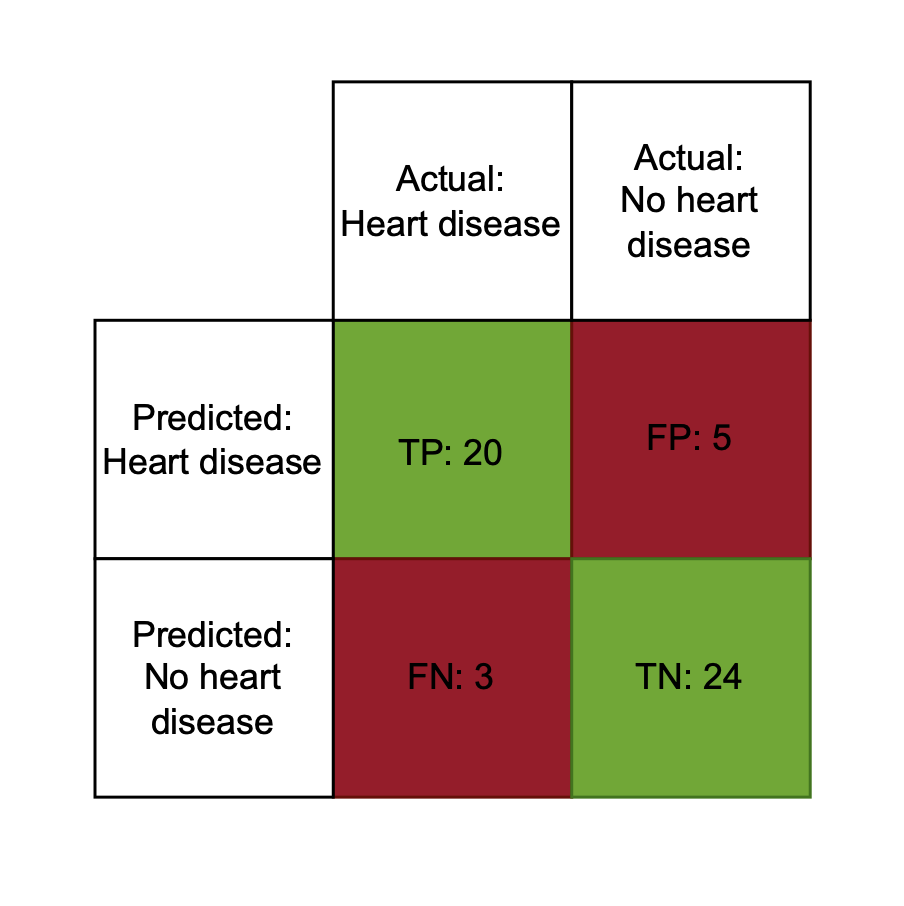
Confusion matrix
True positives (TP)
- ผลการทำนายของโมเดล = การจัดประเภทจริง = บวก
- โมเดลทำนายว่ามีโรคหัวใจ และผู้ป่วยมีโรคหัวใจจริง
False positives (FP)
- ผลการทำนายของโมเดล = บวก, การจัดประเภทจริง = ลบ
- โมเดลทำนายว่ามีโรคหัวใจ แต่ผู้ป่วยไม่มีโรคหัวใจ
False negatives (FN)
- ผลการทำนายของโมเดล = ลบ, การจัดประเภทจริง = บวก
- โมเดลทำนายว่าไม่มีโรคหัวใจ แต่ผู้ป่วยมีโรคหัวใจจริง
True negatives (TN)
- ผลการทำนายของโมเดล = การจัดประเภทจริง = ลบ
- โมเดลทำนายว่าไม่มีโรคหัวใจ และผู้ป่วยไม่มีโรคหัวใจจริง
Balanced accuracy
- เมตริกที่ดีกว่าความแม่นยำแบบธรรมดาสำหรับโมเดล binary classification ส่วนใหญ่
- ให้ค่าเฉลี่ยถ่วงน้ำหนักระหว่างทั้งสองคลาส
- Balanced accuracy = (TP + TN) / 2
from sklearn.metrics import balanced_accuracy_score

# Assume y_test is the true labels and y_pred are the predicted labels
y_pred = model.predict(X_test)
bal_accuracy = balanced_accuracy_score(y_test, y_pred)
print(f"Balanced Accuracy: {bal_accuracy:.2f}")
Balanced Accuracy: 0.85
การใช้งาน Confusion matrix
Cross validation
Cross-validation
- กระบวนการ resampling
- ช่วยให้ผลลัพธ์มีความแข็งแกร่ง
k-fold cross-validation
- พารามิเตอร์ 'k' = จำนวนการแบ่งชุดข้อมูล
- สุ่ม train/test split ใหม่ในแต่ละรอบการสร้างโมเดล
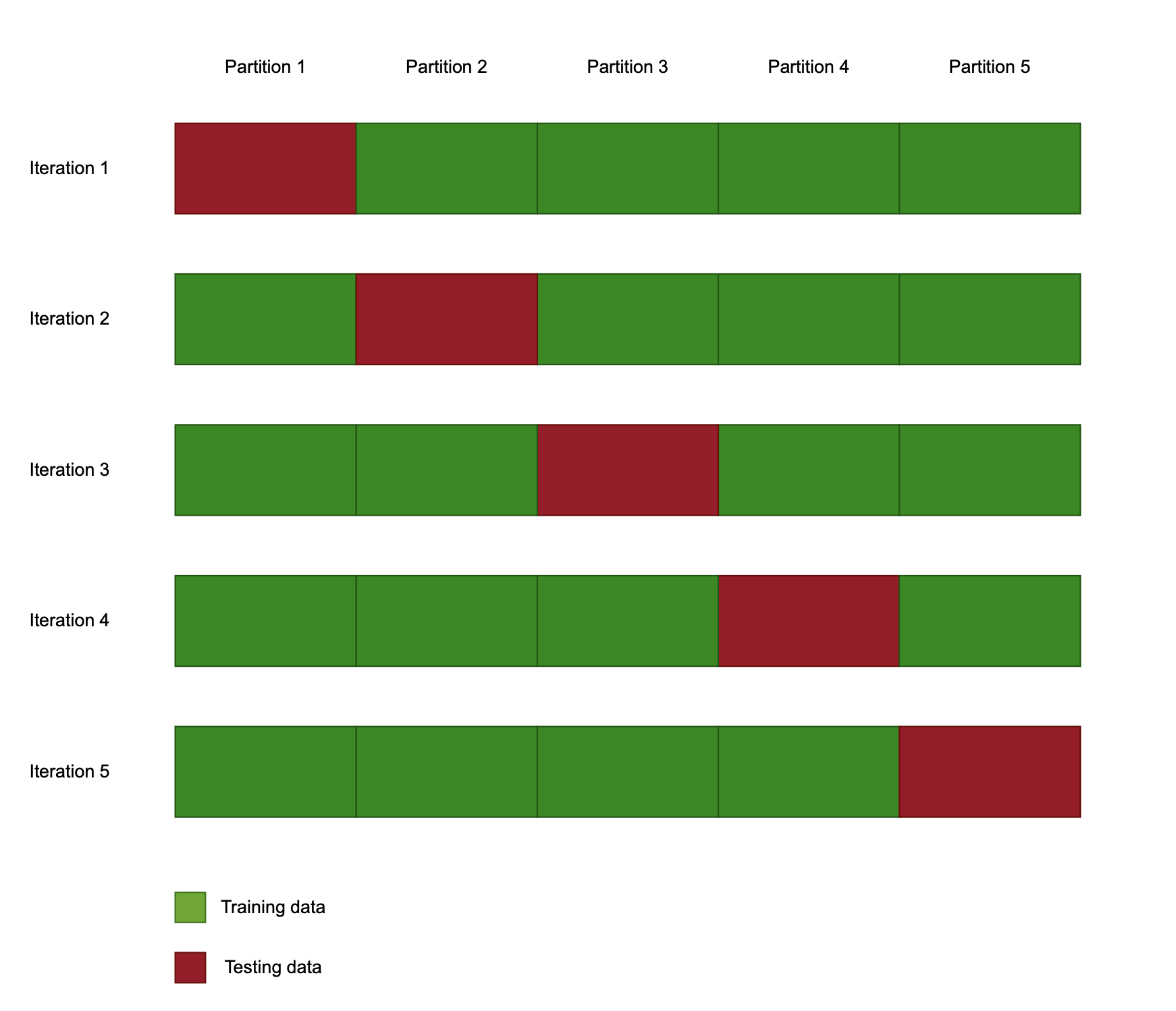
การใช้งาน Cross validation
- การใช้งาน k-fold cross validation ด้วย sklearn ที่ตรงไปตรงมา
- การให้คะแนนที่ไม่ขึ้นกับโมเดล
การใช้งาน:
from sklearn.model_selection import cross_val_score, KFold # split the data into 10 equal parts kfold = KFold(n_splits=5, shuffle=True, random_state=42)# get the cross validation accuracy for a given model cv_results = cross_val_score(model, heart_disease_X, heart_disease_y, cv=kfold, scoring='balanced_accuracy')
Hyperparameter tuning
Hyperparameter:
- พารามิเตอร์ระดับ global ของโมเดล (ไม่เปลี่ยนแปลงระหว่างการเทรน)
- ปรับเพื่อเพิ่มประสิทธิภาพของโมเดล
# Hyperparameters to test
C_values = [0.001, 0.01, 0.1, 1, 10, 100, 1000]

# Manually iterate over the hyperparameters
for C in C_values:
    model = LogisticRegression(max_iter=200, C=C)
    model.fit(X_train, y_train)
    accuracy = cross_val_score(model, X, y, cv=kfold, scoring='balanced_accuracy')
    print(f"C = {C}: Bal Acc: {accuracy.mean():.4f} (+/- {accuracy.std():.4f})")
ตัวอย่าง Hyperparameter tuning
ตัวอย่างผลลัพธ์ของ hyperparameter tuning:
C = 0.001: Bal Acc: 0.6200 (+/- 0.0215)
C = 0.01: Bal Acc: 0.7325 (+/- 0.0234)
C = 0.1: Bal Acc: 0.7923 (+/- 0.0202)
C = 1: Bal Acc: 0.8050 (+/- 0.0191)
C = 10: Bal Acc: 0.8034 (+/- 0.0185)
C = 100: Bal Acc: 0.8021 (+/- 0.0187)
C = 1000: Bal Acc: 0.8017 (+/- 0.0188)
มาฝึกกันเถอะ!
Machine Learning แบบ End-to-End

