Tensorer, lager och autoencoders

Introduktion till djupinlärning med Keras

Miguel Esteban

Data Scientist & Founder

Åtkomst till Keras-lager

# Acessing the first layer of a Keras model
first_layer = model.layers[0]

# Printing the layer, and its input, output and weights print(first_layer.input) print(first_layer.output) print(first_layer.weights)
<tf.Tensor 'dense_1_input:0' shape=(?, 3) dtype=float32>
<tf.Tensor 'dense_1/Relu:0' shape=(?, 2) dtype=float32>
[<tf.Variable 'dense_1/kernel:0' shape=(3, 2) dtype=float32_ref>,
 <tf.Variable 'dense_1/bias:0' shape=(2,) dtype=float32_ref>]
Introduktion till djupinlärning med Keras

Vad är tensorer?

# Defining a rank 2 tensor (2 dimensions)
T2 = [[1,2,3],
      [4,5,6],
      [7,8,9]]

# Defining a rank 3 tensor (3 dimensions) T3 = [[1,2,3], [4,5,6], [7,8,9], [10,11,12], [13,14,15], [16,17,18], [19,20,21], [22,23,24], [25,26,27]]
Introduktion till djupinlärning med Keras
# Import Keras backend
import tensorflow.keras.backend as K

# Get the input and output tensors of a model layer inp = model.layers[0].input out = model.layers[0].output
# Function that maps layer inputs to outputs inp_to_out = K.function([inp], [out])
# We pass and input and get the output we'd get in that first layer print(inp_to_out([X_train])
# Outputs of the first layer per sample in X_train
[array([[0.7, 0],...,[0.1, 0.3]])]
Introduktion till djupinlärning med Keras

Introduktion till djupinlärning med Keras

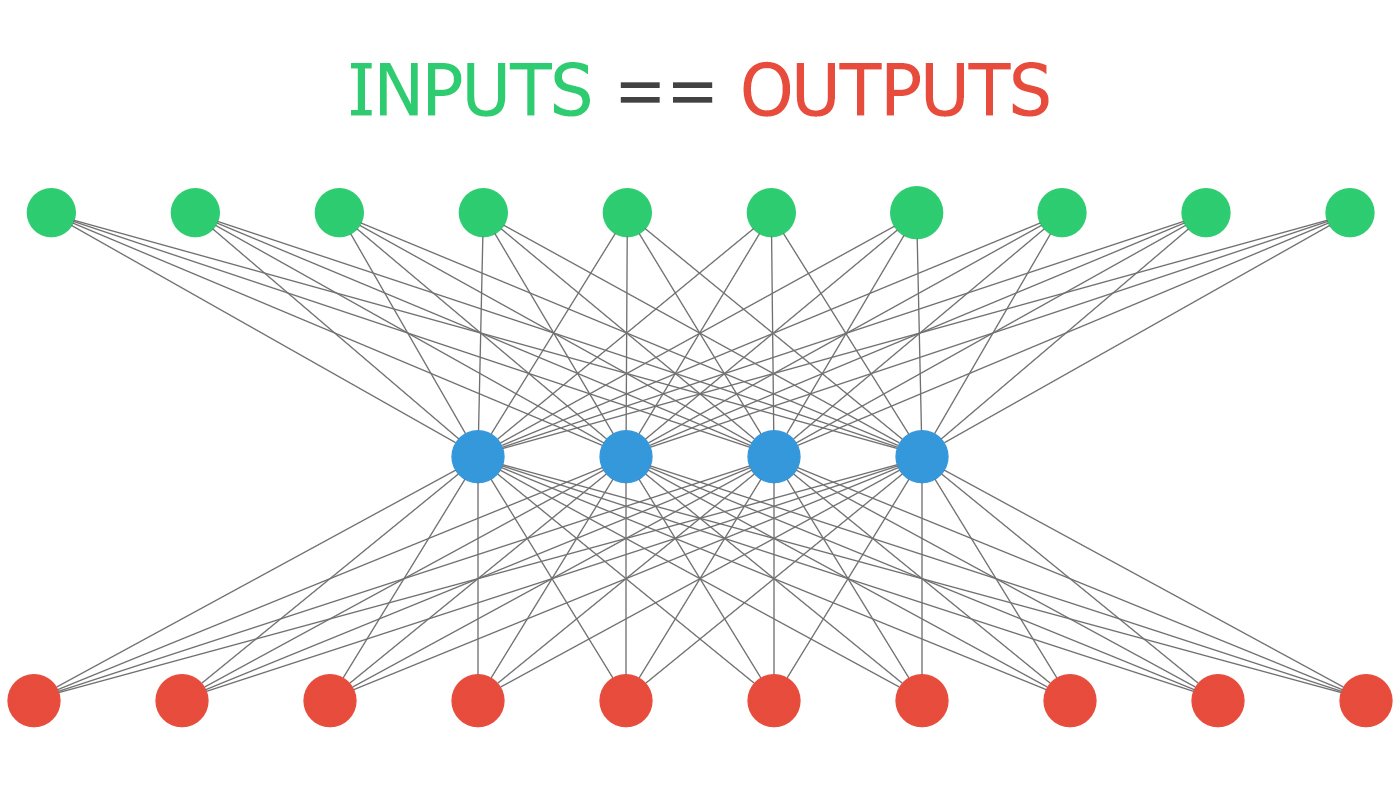
Autoencoders!

Introduktion till djupinlärning med Keras

Autoencoders!

Introduktion till djupinlärning med Keras

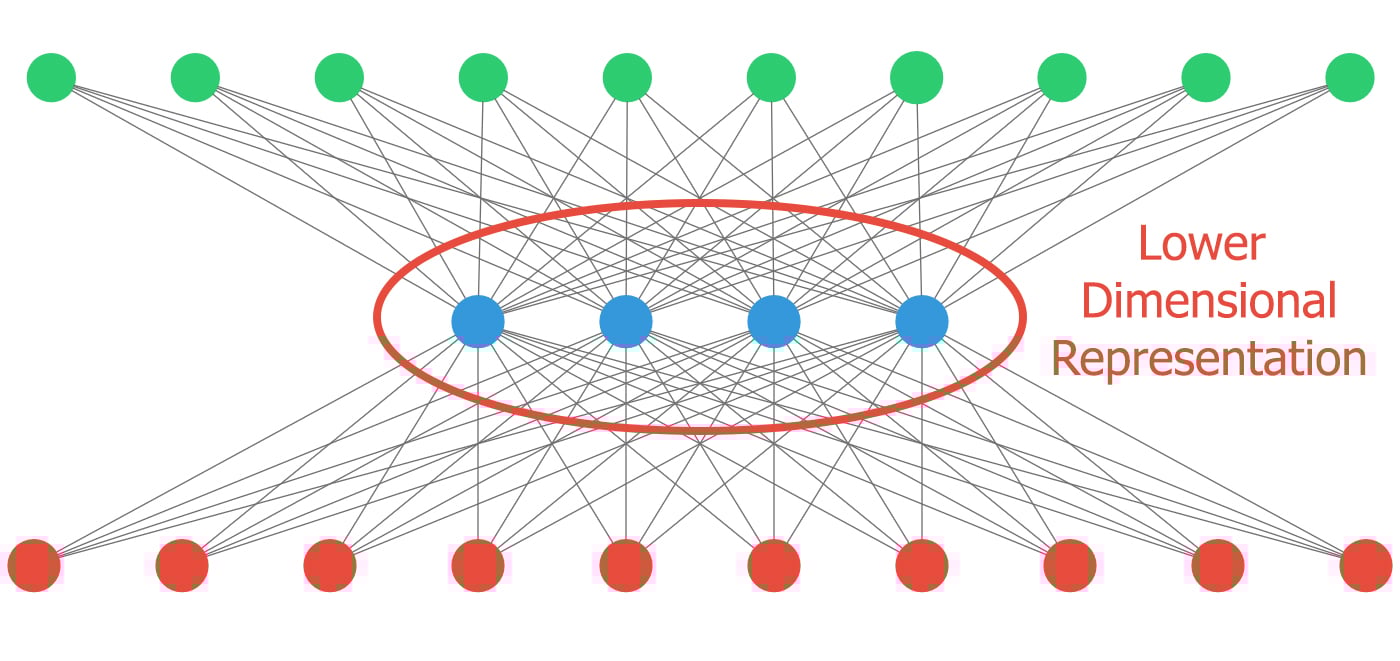
Användningsområden för autoencoders

  • Dimensionsreduktion:
    • Kompakt representation av indata i ett lägredimensionellt rum.
  • Brusreducering:
    • Vid träning på ren data filtreras irrelevant brus bort vid rekonstruktion.
  • Anomalidetektion:
    • Okänd indata ger en sämre rekonstruktion.
  • ...

Introduktion till djupinlärning med Keras

Bygga en enkel autoencoder

# Instantiate a sequential model
autoencoder = Sequential()

# Add a hidden layer of 4 neurons and an input layer of 100 autoencoder.add(Dense(4, input_shape=(100,), activation='relu'))
# Add an output layer of 100 neurons autoencoder.add(Dense(100, activation='sigmoid'))
# Compile your model with the appropiate loss autoencoder.compile(optimizer='adam', loss='binary_crossentropy')
Introduktion till djupinlärning med Keras

Bryta ut en encoder

# Building a separate model to encode inputs
encoder = Sequential()
encoder.add(autoencoder.layers[0])

# Predicting returns the four hidden layer neuron outputs encoder.predict(X_test)
# Four numbers for each observation in X_test
array([10.0234375, 5.833543, 18.90444, 9.20348],...)
Introduktion till djupinlärning med Keras

Nu kör vi en övning!

Introduktion till djupinlärning med Keras

Preparing Video For Download...