ผลตอบแทนของปัจจัยความเสี่ยง

Quantitative Risk Management in R

Alexander McNeil

Professor, University of York

ผลตอบแทนของปัจจัยความเสี่ยง

  • การเปลี่ยนแปลงของปัจจัยความเสี่ยงเรียกว่า ผลตอบแทนของปัจจัยความเสี่ยง หรือ returns
  • ให้ ($Z_t$) แทนอนุกรมเวลาของค่าปัจจัยความเสี่ยง
  • นิยามทั่วไปของ returns ($X_t$)

    • $X_t = Z_t - Z_{t-1}$ (simple returns)

    • $X_t = \dfrac{Z_t - Z_{t-1}}{Z_{t-1}}$ (relative returns)

      • 0.02 = กำไร 2%, -0.03 = ขาดทุน 3%
    • $X_t = \ln(Z_t) - \ln(Z_{t-1})$ (log-returns)
Quantitative Risk Management in R

คุณสมบัติของ log-returns

  • ปัจจัยความเสี่ยงที่ได้จะไม่ติดลบ
  • ใกล้เคียง relative returns มากเมื่อการเปลี่ยนแปลงมีค่าน้อย:

    • $\ln(Z_t) - \ln(Z_{t-1}) \approx \dfrac{Z_t-Z_{t-1}}{Z_{t-1}}$
  • รวมด้วยการบวกเพื่อให้ได้ log-returns ในช่วงเวลาที่ยาวขึ้นได้ง่าย
  • มีการแจกแจงปกติอิสระ หากปัจจัยความเสี่ยงเป็นไปตาม geometric Brownian motion (GBM)
Quantitative Risk Management in R

Log-returns ใน R

sp500x <- diff(log(SP500))
head(sp500x, n = 3)  # note the NA in first position
                 ^GSPC
1950-01-03          NA
1950-01-04 0.011340020
1950-01-05 0.004736539
sp500x <- diff(log(SP500))[-1]
head(sp500x)
                  ^GSPC
1950-01-04  0.011340020
1950-01-05  0.004736539
1950-01-06  0.002948985
1950-01-09  0.005872007
1950-01-10 -0.002931635
1950-01-11  0.003516944
Quantitative Risk Management in R

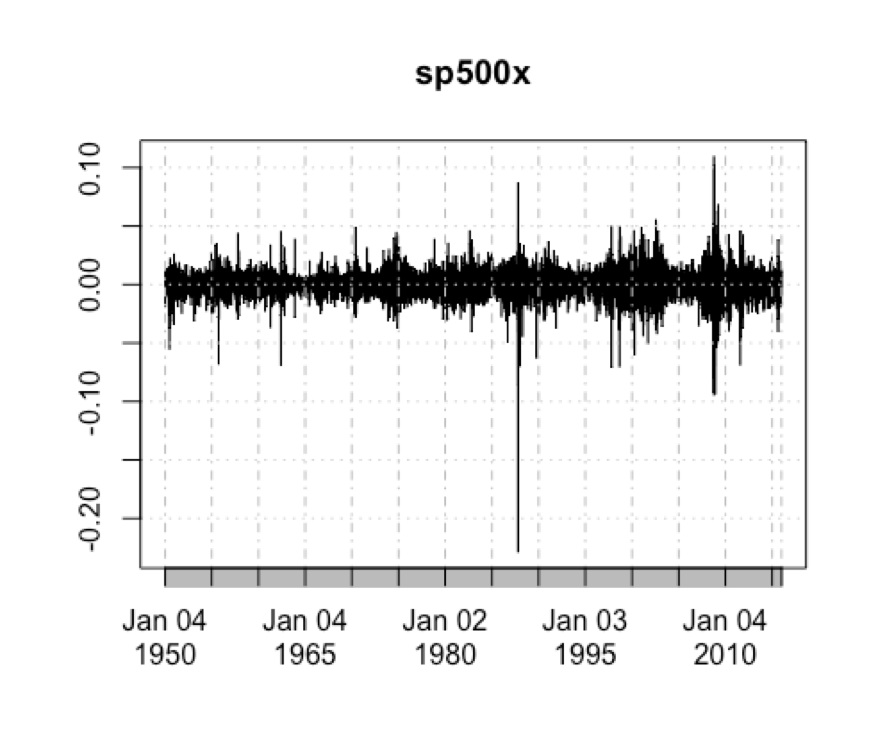
Log-returns ใน R (2)

plot(sp500x)

Quantitative Risk Management in R

มาฝึกกันเถอะ!

Quantitative Risk Management in R

Preparing Video For Download...