การ Fitting โมเดล Cox Proportional Hazards
Survival Analysis ด้วย Python

Shae Wang
Senior Data Scientist
ฟังก์ชันอันตรายและอัตราอันตราย
ฟังก์ชันอันตราย $h(t)$: อธิบายความน่าจะเป็นที่เหตุการณ์จะเกิดขึ้น ณ เวลาหนึ่ง โดยที่รอดชีวิตมาจนถึงเวลานั้น
อัตราอันตราย: อัตราการเกิดเหตุการณ์แบบทันที
$$h(t)=-\frac{d}{dt}logS(t)$$
ฟังก์ชันอันตราย $h(t)$ และ ฟังก์ชันการรอดชีวิต $S(t)$ สามารถคำนวณจากกันและกันได้
สมมติฐาน Proportional Hazards
สมมติฐาน Proportional Hazards: อันตรายของแต่ละบุคคลเป็นสัดส่วนซึ่งกันและกัน
ในกรณีของบุคคล $A$ และบุคคล $B$: $$h_A(t)=ch_B(t)$$
- มี ฟังก์ชันอันตรายพื้นฐาน และอันตรายอื่นระบุด้วย ตัวคูณปรับขนาด
- ผลกระทบต่อการรอดชีวิตสัมพัทธ์ ที่เกี่ยวข้องกับ ตัวแปร ไม่เปลี่ยนแปลงตามเวลา (time-invariant)
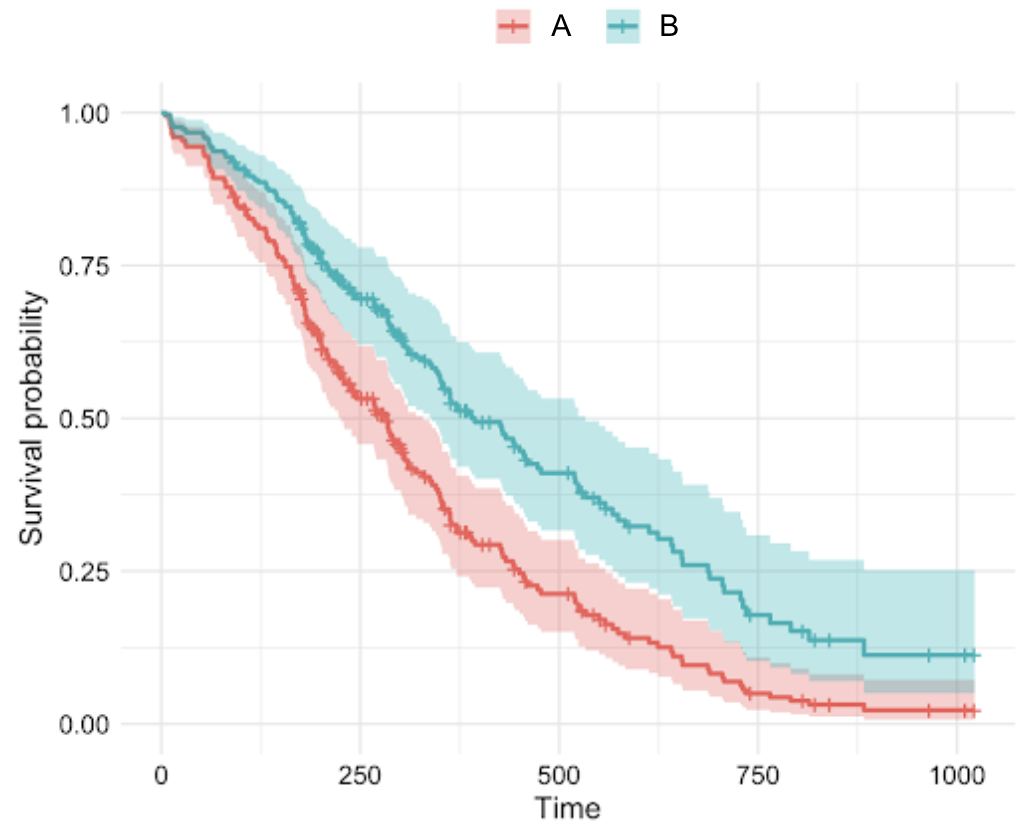
โมเดล Cox Proportional Hazards
อิงตามสมมติฐาน Proportional Hazards: $$h(t|x)=b_0(t)exp\bigg(\sum^{n}_{i=1}b_i(x_i-\overline{x_i}\bigg)$$
$b_0(t)$: ฟังก์ชันอันตรายพื้นฐานระดับประชากรที่เปลี่ยนแปลงตามเวลา
$exp\bigg(\sum^{n}_{i=1}b_i(x_i-\overline{x_i}\bigg)$: ความสัมพันธ์เชิงเส้นระหว่าง covariate กับ log ของอันตราย ซึ่งไม่เปลี่ยนแปลงตามเวลา
- โมเดล Cox Proportional Hazards (Cox PH) คือ โมเดลการถดถอย ที่ถดถอย covariate บนเวลาจนถึงเหตุการณ์/ระยะเวลา
ข้อกำหนดข้อมูลสำหรับโมเดล Cox PH
- Durations: ช่วงเวลา/อายุขัยของแต่ละบุคคล
- Events: ระบุว่าเหตุการณ์ถูกสังเกตหรือไม่ (1=ใช่, 0=ไม่ใช่, censored)
- หากไม่ระบุ โมเดลจะถือว่าไม่มีผู้ถูก censored
- Covariates: ตัวแปรต่อเนื่องหรือตัวแปรหมวดหมู่แบบ one-hot encoded สำหรับการถดถอย
การ Fit โมเดล Cox PH
- Import และสร้าง instance ของคลาส
CoxPHFitterfrom lifelines import CoxPHFitter coxph = CoxPHFitter() - เรียก
.fit()เพื่อ fit estimator กับข้อมูลcoxph.fit(df, duration_col, event_col) - เข้าถึง property อื่นเพื่อตรวจสอบสรุปโมเดล, covariate, coefficients, พยากรณ์, พล็อต ฯลฯ
coxph.summary()
coxph.predict()
ตัวอย่างโมเดล Cox PH
- DataFrame:
mortgage_df - Covariates:
houseprincipalinterestproperty_taxcredit_score
- คอลัมน์อื่น:
duration,paid_off
from lifelines import CoxPHFittercoxph = CoxPHFitter() coxph.fit(df=mortgage_df, duration_col="duration", event_col="paid_off")
โมเดลแบบกำหนดเอง
กรอง DataFrame:
new_df = mortgage_df.loc[:,
          mortgage_df.columns!="house"]
coxph.fit(df=new_df,
          duration_col="duration",
          event_col="paid_off")
ใช้พารามิเตอร์ formula:
coxph.fit(df=mortgage_df,
          duration_col="duration",
          event_col="paid_off",
          formula="principal + interest
          + property_tax + credit_score")
- สะดวกและชัดเจนกว่า แต่ไม่เหมาะเมื่อมี covariate จำนวนมาก
การแปลความหมาย coefficients
print(coxph.summary)
<lifelines.CoxPHFitter: fitted with 1808 observations, 340 censored>
                        coef  exp(coef)  se(coef)      z       p
covariate house        -0.38       0.68      0.19. -1.98    0.05
          principal    -0.06       0.94      0.02  -2.61    0.01
          interest      0.31       1.37      0.31   1.02    0.31
          property_tax -0.15       0.86      0.21  -0.71    0.48
          credit_score -0.43       0.65      0.38  -1.14.   0.26
- Hazard ratio: $e^{coef}$
- การเพิ่มขึ้นหนึ่งหน่วยของ
interestจากค่ามัธยฐาน -> อันตรายเปลี่ยนแปลงด้วยตัวคูณ $e^{0.31}=1.37$ ซึ่งเพิ่มขึ้น 37% เมื่อเทียบกับอันตรายพื้นฐาน
- การเพิ่มขึ้นหนึ่งหน่วยของ
มาฝึกกันเถอะ!
Survival Analysis ด้วย Python

