Supervised learning pipelines
การออกแบบ Machine Learning Workflows ด้วย Python

Dr. Chris Anagnostopoulos
Honorary Associate Professor
ข้อมูลที่มีป้ายกำกับ
- ตัวแปรฟีเจอร์ (ย่อว่า
X) - ป้ายกำกับหรือคลาส (ย่อว่า
y)
credit_scoring.head(4)
  checking_status  duration  ...  foreign_worker class
0            '<0'         6  ...             yes  good
1      '0<=X<200'        48  ...             yes   bad
2   'no checking'        12  ...             yes  good
3            '<0'        42  ...             yes  good
Feature engineering
- classifier ส่วนใหญ่ต้องการฟีเจอร์ที่เป็นตัวเลข
- ต้องแปลงคอลัมน์ที่เป็น string ให้เป็นตัวเลข
ประมวลผลล่วงหน้าด้วย LabelEncoder จาก sklearn.preprocessing:
le = LabelEncoder()
le.fit_transform(credit_scoring['checking_status'])[:4]
array([1, 0, 3, 1])
การ fit โมเดล
.fit(features, labels).predict(features)
features, labels = credit_scoring.drop('class', 1), credit_scoring['class']model_nb = GaussianNB() model_nb.fit(features, labels) model_nb.predict(features.head(5))
['good' 'bad' 'good' 'bad' 'good']
ความแม่นยำ 60% บน 5 ตัวอย่างแรก
การเลือกโมเดล
.fit()ปรับพารามิเตอร์ของโมเดลให้เหมาะสม- แล้วโมเดลอื่นล่ะ?
AdaBoostClassifier ทำได้ดีกว่า GaussianNB บน 5 จุดข้อมูลแรก:
model_ab = AdaBoostClassifier()
model_ab.fit(features, labels)
model_ab.predict(features.head(5))
numpy.array(labels[0:5])
['good' 'bad' 'good' 'good' 'bad']
['good' 'bad' 'good' 'good' 'bad']
การประเมินประสิทธิภาพ
ขนาดตัวอย่างที่มากขึ้น $\Rightarrow$ การประมาณค่าความแม่นยำที่ดีขึ้น:
from sklearn.metrics import accuracy_score
accuracy_score(labels, model_nb.predict(features)) # naive bayes
0.706
accuracy_score(labels, model_ab.predict(features)) # adaboost
0.802
การคำนวณนี้มีปัญหาอะไร?
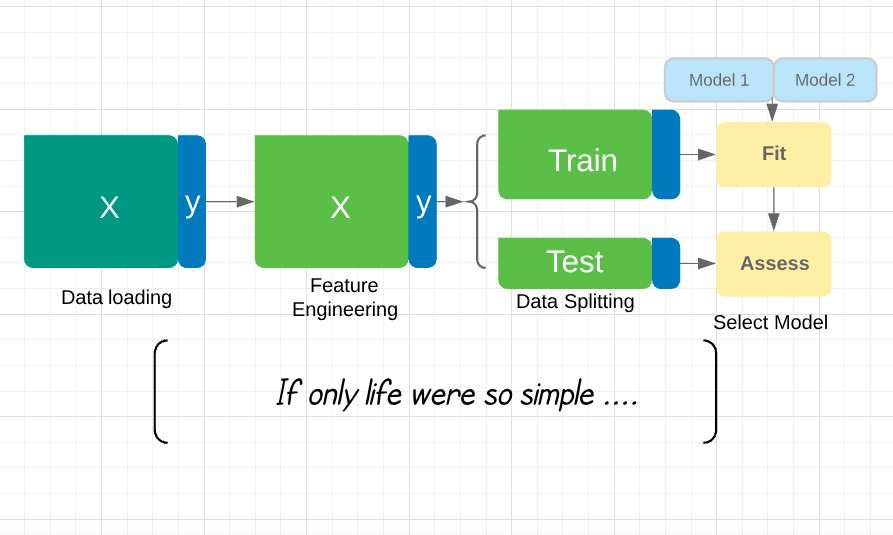
Overfitting และการแบ่งข้อมูล
Overfitting: โมเดลมักทำงานได้ดีกว่าบนข้อมูลที่ใช้ฝึก เมื่อเทียบกับข้อมูลที่ยังไม่เคยเห็น
ฝึกบน X_train, y_train และประเมินความแม่นยำบน X_test, y_test:
from sklearn.model_selection import train_test_split X_train, X_test, y_train, y_test = train_test_split(X, y, test_size=0.2)GaussianNB().fit(X_train, y_train).predict(X_test)
คอร์สนี้เกี่ยวกับอะไร?
- วิธีปรับแต่ง pipeline ของคุณให้รองรับการขยายขนาด
- ทำให้การพยากรณ์มีความเกี่ยวข้อง โดยให้ผู้เชี่ยวชาญด้านสาขามีส่วนร่วม
- ดูแลให้โมเดลยังคงทำงานได้ดีในระยะยาว
- การ fit โมเดลเมื่อมีป้ายกำกับไม่เพียงพอ
คุณจะป้องกันวิกฤตสินเชื่อที่อยู่อาศัยได้ไหม?
การออกแบบ Machine Learning Workflows ด้วย Python

