GARCH Models in R
Kris Boudt
Professor of finance and econometrics
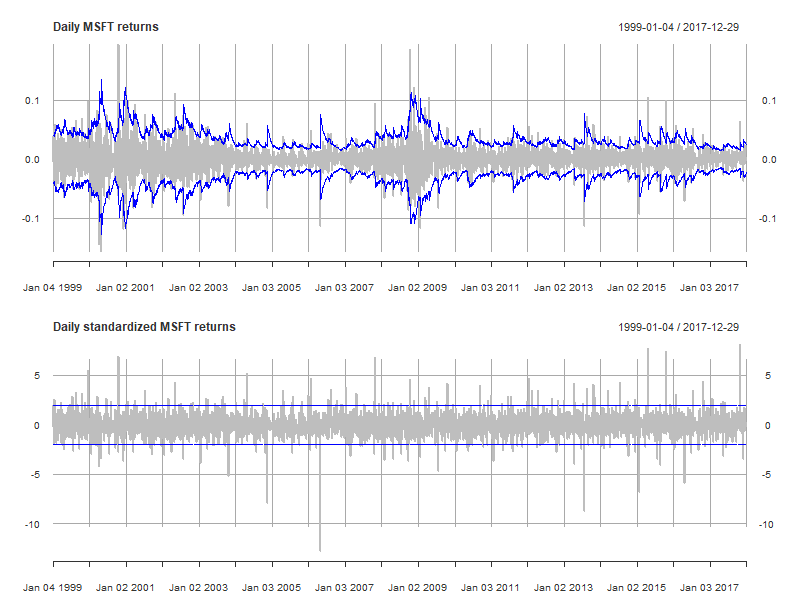
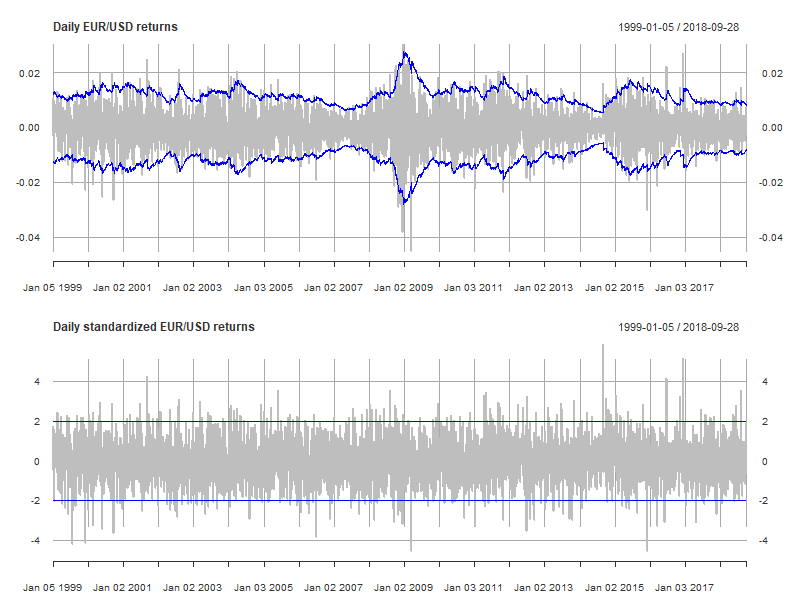
สูตรผลตอบแทนมาตรฐาน
$$ Z_{t} = \frac{R_{t} - \hat{\mu_{t}}}{ \hat{\sigma_{t}}} $$
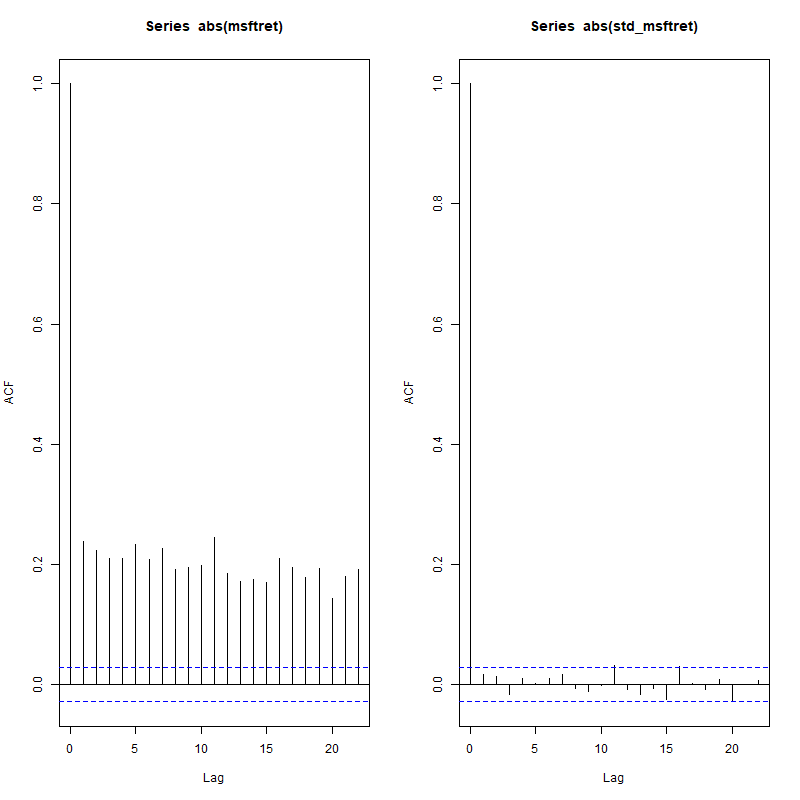
การตรวจสอบความถูกต้องของโมเดลครั้งที่ 3:
เหตุใด?
acf()
garchspec <- ugarchspec(mean.model = list(armaOrder = c(1, 0)),
                        variance.model = list(model = "gjrGARCH"),
                        distribution.model = "sstd")
garchfit <- ugarchfit(data = msftret, spec = garchspec)
stdmsftret <- residuals(garchfit, standardize = TRUE)
acf(abs(msftret), 22)
acf(abs(stdmsftret), 22)
กฎเบื้องต้น: หาก p-value น้อยกว่า 5% แสดงว่าโมเดลที่ใช้ไม่ถูกต้อง
Box.test()
type = "Ljung-Box"
ตัวอย่าง:
Box.test(abs(stdmsftret), 22, type = "Ljung-Box")
ทดสอบกับค่าสัมบูรณ์ของผลตอบแทนมาตรฐาน:
    Box-Ljung test
data:  abs(stdmsftret)
X-squared = 25.246, df = 22, p-value = 0.2855
หมายเหตุ: p-value คือ 28.55% > 5% จึงไม่สามารถปฏิเสธว่า: $$ H_0: Corr(|Z_t|,|Z_{t-1}|) = Corr(|Z_t|,|Z_{t-2}|) = ... = Corr(|Z_t|,|Z_{t-22}|) = 0 $$