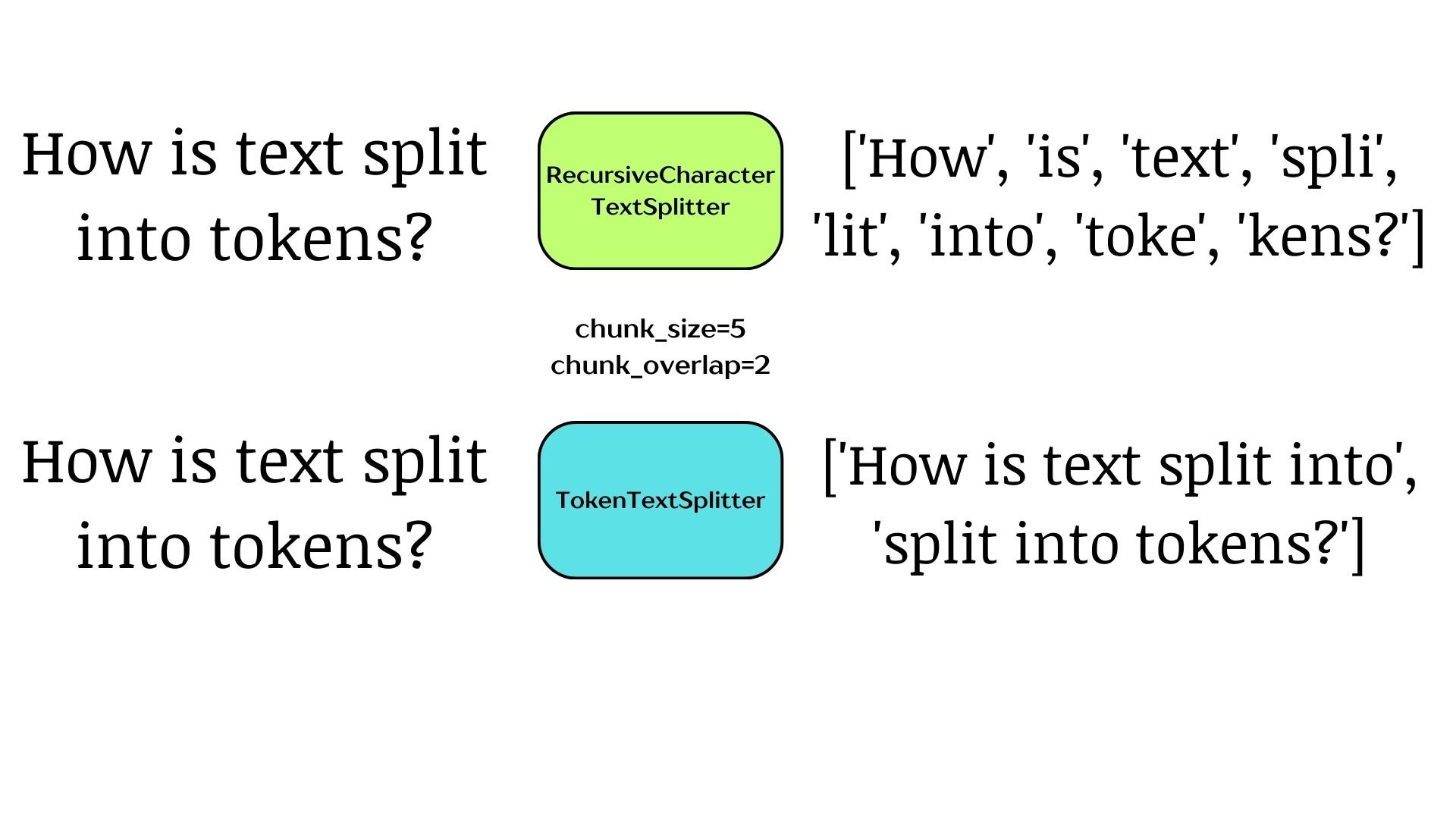
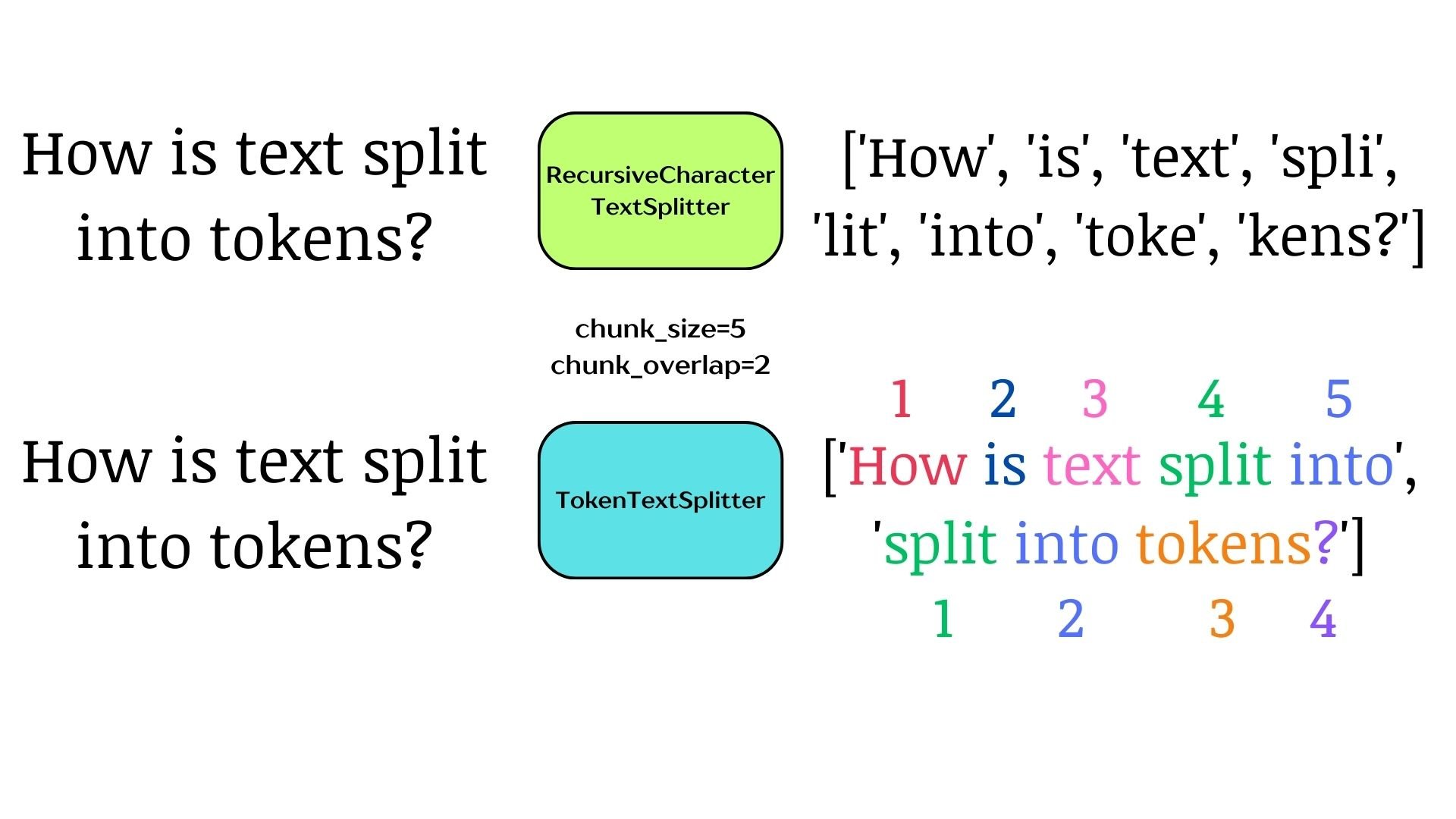
import tiktoken
from langchain_text_splitters import TokenTextSplitter
example_string = "Mary had a little lamb, it's fleece was white as snow."

encoding = tiktoken.encoding_for_model('gpt-4o-mini')
splitter = TokenTextSplitter(encoding_name=encoding.name,
                             chunk_size=10,
                             chunk_overlap=2)


chunks = splitter.split_text(example_string)

for i, chunk in enumerate(chunks):
    print(f"Chunk {i+1}:\n{chunk}\n")
以 tokens 分割
Chunk 1:
Mary had a little lamb, it's fleece

Chunk 2:
 fleece was white as snow.
以 tokens 分割
for i, chunk in enumerate(chunks):
    print(f"Chunk {i+1}:\nNo. tokens: {len(encoding.encode(chunk))}\n{chunk}\n")
Chunk 1:
No. tokens: 10
Mary had a little lamb, it's fleece was

Chunk 2:
No. tokens: 6
 fleece was white as snow.
語意分割
語意分割
語意分割
語意分割
from langchain_openai import OpenAIEmbeddings
from langchain_experimental.text_splitter import SemanticChunker


embeddings = OpenAIEmbeddings(api_key="...", model='text-embedding-3-small')


semantic_splitter = SemanticChunker(
    embeddings=embeddings,

    breakpoint_threshold_type="gradient",
    breakpoint_threshold_amount=0.8

)
page_content='Retrieval-Augmented Generation for\nKnowledge-Intensive NLP Tasks\ Patrick Lewis,
Ethan Perez,\nAleksandra Piktus, Fabio Petroni, Vladimir Karpukhin, Naman Goyal, Heinrich
Küttler,\nMike Lewis, Wen-tau Yih, Tim Rocktäschel, Sebastian Riedel, Douwe Kiela\nFacebook AI
Research; University College London;New York University;\[email protected]\nAbstract\nLarge
pre-trained language models have been shown to store factual knowledge\nin their parameters,
and achieve state-of-the-art results when fine-tuned on down-\nstream NLP tasks. However, their
ability to access and precisely manipulate knowl-\nedge is still limited, and hence on
knowledge-intensive tasks, their performance\nlags behind task-specific architectures.'
metadata={'source': 'rag_paper.pdf', 'page': 0}