Developing Machine Learning Models for Production
Sinan Ozdemir
Data Scientist, Entrepreneur, and Author
封裝方法
序列化:儲存與讀取 ML 模型
環境封裝:為 ML 模型提供一致、可重現的環境
容器化:把模型、相依項與環境打包進單一「container」
使用 pickle 序列化 sklearn 模型:
import pickle
model = ... # Train the scikit-learn model
# Serialize the model to a file
with open('model.pkl', 'wb') as f:
pickle.dump(model, f)
# Load the serialized model from the file
with open('model.pkl', 'rb') as f:
model = pickle.load(f)
以 HDF5 格式序列化 sklearn 模型:
import h5py
import numpy as np
from sklearn.externals import joblib
model = ... # Train the scikit-learn model
# Serialize the model to an HDF5 file
with h5py.File('model.h5', 'w') as f:
f.create_dataset('model_weights',
data=joblib.dump(model))
# Load the serialized model from the HDF5 file
with h5py.File('model.h5', 'r') as f:
model = joblib.load(f['model_weights'][:])
序列化 PyTorch 模型:
import torch
# Train a PyTorch model and store it in a variable
trained_model = ...
# Serialize the trained model to a file
serialized_model_path = 'model.pt'
torch.save(trained_model.state_dict(), serialized_model_path)
# Load the serialized model from a file
loaded_model = ... # Initialize the model
loaded_model.load_state_dict(
torch.load(serialized_model_path))
序列化 Tensorflow 模型:
import tensorflow as tf
# Train a Tensorflow model
trained_model = ...
# Save the trained model to a directory
saved_model_directory = 'model/'
tf.saved_model.save
(trained_model, saved_model_directory)
# Load the saved model from the directory
loaded_model = tf.saved_model.load(
saved_model_directory)

# Use an existing image as the base image
FROM python:3.8-slim
# Set the working directory
WORKDIR /app
# Copy the requirements file to the image
COPY requirements.txt .
# Install the required dependencies
RUN pip install -r requirements.txt
# Copy the ML model and its dependencies to the image
COPY model/ .
# Set the entrypoint to run the model
ENTRYPOINT ["python", "run_model.py"]
<---- 使用 Python 3.8 基底映像
<---- 設定工作目錄
<---- 複製 requirmentes.txt 檔案
<---- 安裝模型所需的相依套件
<---- 複製模型到容器中
<---- 指定容器的啟動方式
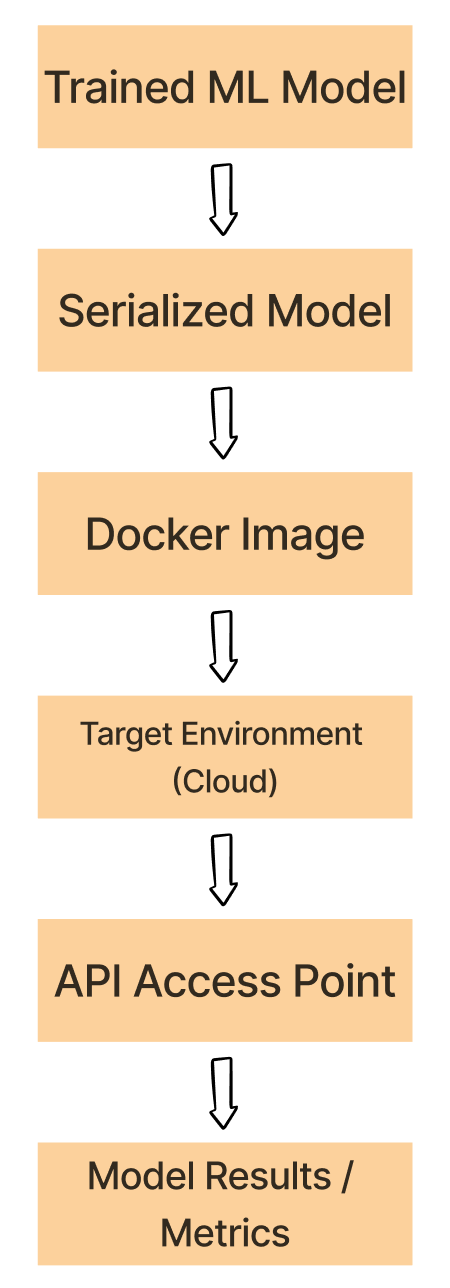
使用 pickle、HDF5 或 PyTorch 等格式將已訓練的 ML 模型進行序列化。
將序列化後的模型、相依項與環境進行容器化
將 Docker 映像部署到目標環境(如雲端平台)
由已部署的映像啟動 Docker 容器,並執行 ML 模型。
透過 API 或其他介面在容器內使用該模型。

Developing Machine Learning Models for Production