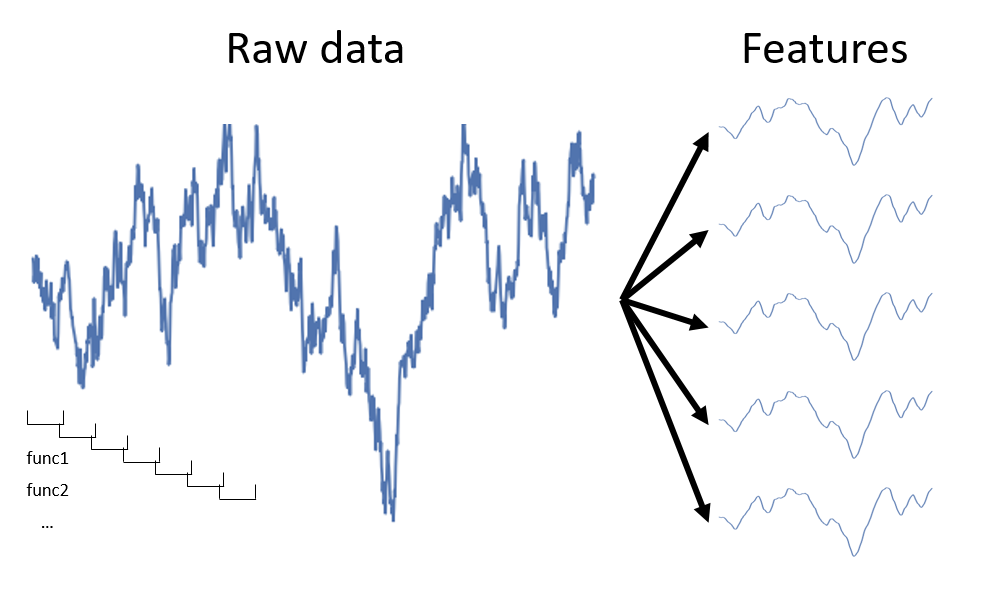
隨時間建立特徵

Python 的時間序列資料機器學習

Chris Holdgraf

Fellow, Berkeley Institute for Data Science

用視窗擷取特徵

Python 的時間序列資料機器學習

用 .aggregate 進行特徵擷取

# Visualize the raw data
print(prices.head(3))
symbol            AIG        ABT
date                            
2010-01-04  29.889999  54.459951
2010-01-05  29.330000  54.019953
2010-01-06  29.139999  54.319953
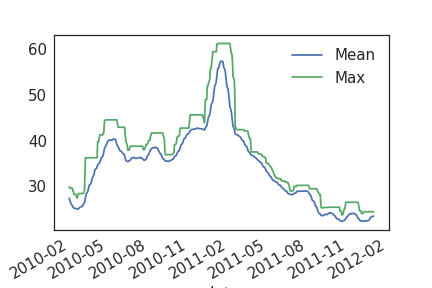
# Calculate a rolling window, then extract two features
feats = prices.rolling(20).aggregate([np.std, np.max]).dropna()
print(feats.head(3))
                 AIG                  ABT           
                 std       amax       std       amax
date                                                
2010-02-01  2.051966  29.889999  0.868830  56.239949
2010-02-02  2.101032  29.629999  0.869197  56.239949
2010-02-03  2.157249  29.629999  0.852509  56.239949
Python 的時間序列資料機器學習

檢查特徵的性質!

Python 的時間序列資料機器學習

在 Python 中使用 partial()

# If we just take the mean, it returns a single value
a = np.array([[0, 1, 2], [0, 1, 2], [0, 1, 2]])
print(np.mean(a))
1.0
# We can use the partial function to initialize np.mean 
# with an axis parameter
from functools import partial
mean_over_first_axis = partial(np.mean, axis=0)

print(mean_over_first_axis(a))
[0. 1. 2.]
Python 的時間序列資料機器學習

用百分位數摘要資料

  • 百分位數能更細緻地摘要資料(不同於使用 np.mean)。
  • 對一個資料集, 第 N 百分位是有 N% 資料小於該值、100−N% 資料大於該值的位置。
print(np.percentile(np.linspace(0, 200), q=20))
40.0
Python 的時間序列資料機器學習

結合 np.percentile() 與 partial 函式計算多個百分位數

data = np.linspace(0, 100)

# Create a list of functions using a list comprehension
percentile_funcs = [partial(np.percentile, q=ii) for ii in [20, 40, 60]]

# Calculate the output of each function in the same way
percentiles = [i_func(data) for i_func in percentile_funcs]
print(percentiles)
[20.0, 40.00000000000001, 60.0]
# Calculate multiple percentiles of a rolling window
data.rolling(20).aggregate(percentiles)
Python 的時間序列資料機器學習

計算「日期型」特徵

  • 目前為止我們著重在計算「統計型」特徵,例如「平均值」、「標準差」等,這些對應到資料的統計性質。
  • 但別忘了,時間序列也常有較「人本」的特徵,如星期幾、節日等。
  • 這些特徵在處理跨越多年的時間序列(如股價走勢)時常很有用。
Python 的時間序列資料機器學習

用 Pandas 擷取 datetime 特徵

# Ensure our index is datetime
prices.index = pd.to_datetime(prices.index)

# Extract datetime features
day_of_week_num = prices.index.weekday
print(day_of_week_num[:10])
Index([0 1 2 3 4 0 1 2 3 4], dtype='object')
day_of_week = prices.index.day_name()
print(day_of_week[:10])
Index(['Monday' 'Tuesday' 'Wednesday' 'Thursday' 'Friday' 'Monday' 'Tuesday'
 'Wednesday' 'Thursday' 'Friday'], dtype='object')
Python 的時間序列資料機器學習

一起來練習吧!

Python 的時間序列資料機器學習

Preparing Video For Download...