集成模型

使用 PySpark 的機器學習

Andrew Collier

Data Scientist, Fathom Data

什麼是集成?

它是一組模型的集合。
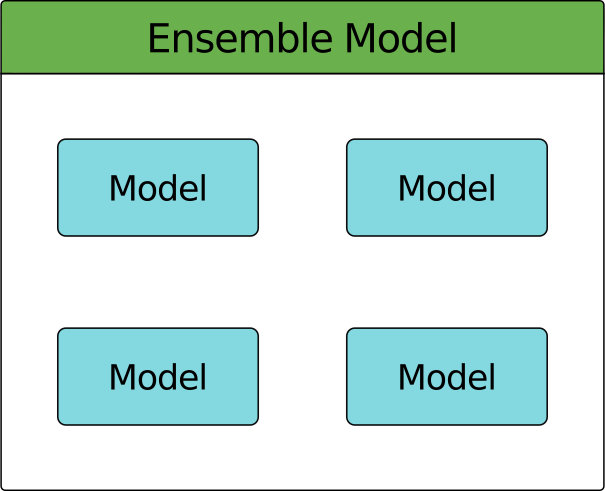
一組相似的模型

群眾智慧——群體的整體判斷往往優於單一專家。

使用 PySpark 的機器學習

集成的多樣性


多樣性獨立性很重要,因為最好的集體決策來自分歧與競爭,而非共識或妥協。

― James Surowiecki,《The Wisdom of Crowds》

使用 PySpark 的機器學習

Random Forest

Random Forest——由多棵 Decision Tree 組成的集成

打造模型多樣性:

  • 每棵樹以資料的「隨機子集」訓練
  • 在每個節點以特徵的「隨機子集」進行切分

森林中的樹不該有兩棵一樣。

一片樹林

使用 PySpark 的機器學習

建立一座樹之森林

回到汽車資料:產地在 USA(0.0)或非 USA(1.0)。

建立 Random Forest 分類器。

from pyspark.ml.classification import RandomForestClassifier

forest = RandomForestClassifier(numTrees=5)

將模型擬合到訓練資料。

forest = forest.fit(cars_train)
使用 PySpark 的機器學習

看到森林裡的樹

如何存取森林中的各棵樹?

forest.trees
[DecisionTreeClassificationModel (uid=dtc_aa66702a4ce9) of depth 5 with 17 nodes,
 DecisionTreeClassificationModel (uid=dtc_99f7efedafe9) of depth 5 with 31 nodes,
 DecisionTreeClassificationModel (uid=dtc_9306e4a5fa1d) of depth 5 with 21 nodes,
 DecisionTreeClassificationModel (uid=dtc_d643bd48a8dd) of depth 5 with 23 nodes,
 DecisionTreeClassificationModel (uid=dtc_a2d5abd67969) of depth 5 with 27 nodes]

每一棵都可用來做個別預測。

使用 PySpark 的機器學習

單棵樹的預測

每棵樹各自產生了哪些預測?

+------+------+------+------+------+-----+
|tree 0|tree 1|tree 2|tree 3|tree 4|label|
+------+------+------+------+------+-----+
|   0.0|   0.0|   0.0|   0.0|   0.0|  0.0| <- 完全一致
|   1.0|   1.0|   0.0|   1.0|   0.0|  0.0|
|   0.0|   0.0|   0.0|   1.0|   1.0|  1.0|
|   0.0|   0.0|   0.0|   1.0|   0.0|  0.0|
|   0.0|   1.0|   1.0|   1.0|   0.0|  1.0|
|   1.0|   1.0|   0.0|   1.0|   1.0|  1.0|
|   1.0|   1.0|   1.0|   1.0|   1.0|  1.0| <- 完全一致
+------+------+------+------+------+-----+
使用 PySpark 的機器學習

共識預測

使用 .transform() 產生共識預測。

+-----+----------------------------------------+----------+
|label|probability                             |prediction|
+-----+----------------------------------------+----------+
|0.0  |[0.8,0.2]                               |0.0       |
|0.0  |[0.4,0.6]                               |1.0       |
|1.0  |[0.5333333333333333,0.4666666666666666] |0.0       |
|0.0  |[0.7177777777777778,0.28222222222222226]|0.0       |
|1.0  |[0.39396825396825397,0.606031746031746] |1.0       |
|1.0  |[0.17660818713450294,0.823391812865497] |1.0       |
|1.0  |[0.053968253968253964,0.946031746031746]|1.0       |
+-----+----------------------------------------+----------+
使用 PySpark 的機器學習

特徵重要性

模型使用的特徵有:cylsizemasslengthrpmconsumption

哪些最重要或最不重要?

forest.featureImportances
SparseVector(6, {0: 0.0205, 1: 0.2701, 2: 0.108, 3: 0.1895, 4: 0.2939, 5: 0.1181})

看起來:

  • rpm 最重要
  • cyl 最不重要。
使用 PySpark 的機器學習

Gradient-Boosted Trees

迭代式提升演算法:

  1. 建立一棵 Decision Tree,加入集成。
  2. 用集成為每個訓練樣本預測標籤。
  3. 將預測與已知標籤比較。
  4. 加強關注預測錯誤的樣本。
  5. 回到步驟 1。

模型在每次迭代都會改進。

使用 PySpark 的機器學習

提升樹模型

建立一個 Gradient-Boosted Tree 分類器。

from pyspark.ml.classification import GBTClassifier

gbt = GBTClassifier(maxIter=10)

將模型擬合到訓練資料。

gbt = gbt.fit(cars_train)
使用 PySpark 的機器學習

比較各種樹模型

我們來比較 3 種樹模型在測試資料上的表現。

# AUC for Decision Tree
0.5875

# AUC for Random Forest
0.65

# AUC for Gradient-Boosted Tree
0.65

兩種集成方法都優於單一的 Decision Tree。

使用 PySpark 的機器學習

把所有模型都集成起來!

使用 PySpark 的機器學習

Preparing Video For Download...
