使用 Scikit Learn 進行 Grid Search
Python 超參數調校

Alex Scriven
Data Scientist
GridSearchCV 物件
介紹一個 GridSearchCV 物件:
sklearn.model_selection.GridSearchCV(
    estimator,
    param_grid, scoring=None, fit_params=None,
    n_jobs=None, refit=True, cv='warn',
    verbose=0, pre_dispatch='2*n_jobs',
    error_score='raise-deprecating',
    return_train_score='warn')
Grid Search 步驟
Grid Search 的步驟:
- 用來調整超參數的演算法(有時稱為「estimator」)
- 定義要調整哪些超參數
- 為每個超參數設定要測試的數值範圍
- 設定交叉驗證方式;以及
- 定義評分函式,用來決定網格中哪一格「最佳」
- 視需要加入其他資訊或功能
GridSearchCV 物件的輸入參數
重要的輸入參數有:
estimatorparam_gridcvscoringrefitn_jobsreturn_train_score
GridSearchCV 的「estimator」
estimator 參數:
- 基本上就是我們的演算法
- 你已經用過 KNN、Random Forest、GBM、Logistic Regression
提醒:
- 每個 GridSearchCV 物件只能有一個 estimator
GridSearchCV 的「param_grid」
param_grid 參數:
- 指定要測試的超參數與其數值
與其用清單:
max_depth_list = [2, 4, 6, 8]
min_samples_leaf_list = [1, 2, 4, 6]
可以改為:
param_grid = {'max_depth': [2, 4, 6, 8],
              'min_samples_leaf': [1, 2, 4, 6]}
GridSearchCV 的「param_grid」
param_grid 參數:
提醒:param_grid 字典中的鍵必須是有效的超參數名稱。
例如,對 Logistic regression 的 estimator:
# Incorrect
param_grid = {'C': [0.1,0.2,0.5],
              'best_choice': [10,20,50]}
ValueError: Invalid parameter best_choice for estimator LogisticRegression
GridSearchCV 的「cv」
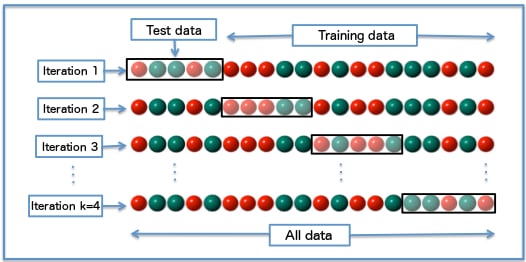
cv 參數:
- 選擇交叉驗證的方式
- 若給整數,則進行 k 折交叉驗證;常見為 5 或 10
GridSearchCV 的「scoring」
scoring 參數:
- 用哪個分數來挑選最佳網格(模型)
- 可用自訂或 Scikit Learn 的
metrics模組
你可以這樣查看所有內建評分函式:
from sklearn import metrics
sorted(metrics.SCORERS.keys())
GridSearchCV 的「refit」
refit 參數:
- 以最佳超參數在訓練資料上重新擬合
- 讓
GridSearchCV物件可直接當成 estimator(用於預測) - 非常實用!
GridSearchCV 的「n_jobs」
n_jobs 參數:
- 協助平行執行
- 可同時建立多個模型,而非逐一建立
實用程式碼:
import os
print(os.cpu_count())
若還要做其他工作,別把所有核心都拿去訓練模型!
GridSearchCV 的「return_train_score」
return_train_score 參數:
- 紀錄已執行訓練的統計資訊
- 有助分析偏差-變異權衡,但會增加計算成本
- 不用來挑選最佳模型,只供分析
建立 GridSearchCV 物件
建立自己的 GridSearchCV 物件:
# Create the grid param_grid = {'max_depth': [2, 4, 6, 8], 'min_samples_leaf': [1, 2, 4, 6]}#Get a base classifier with some set parameters. rf_class = RandomForestClassifier(criterion='entropy', max_features='auto')
建立 GridSearchCv 物件
把元件組合起來:
grid_rf_class = GridSearchCV(
    estimator = rf_class,
    param_grid = parameter_grid,
    scoring='accuracy',
    n_jobs=4,
    cv = 10,
    refit=True,
    return_train_score=True)
使用 GridSearchCV 物件
因為我們將 refit 設為 True,可以直接使用該物件:
#Fit the object to our data
grid_rf_class.fit(X_train, y_train)

# Make predictions
grid_rf_class.predict(X_test)
一起來練習吧!
Python 超參數調校

