用 PCA 進行匿名化
Data Privacy and Anonymization in Python

Rebeca Gonzalez
Data engineer
主成分分析(PCA)
$$ $$ 常見的降維方法,可用來壓縮大型資料集的維度。
用 PCA 進行資料遮罩
PCA 會以原始特徵的線性轉換建立新的「主成分」。
以啤酒資料集為例,PCA 會構造新特徵。例如:
$$ 2\times AlcoholicVolume - BitternessLevel$$
用 PCA 進行資料遮罩
資料的新投影
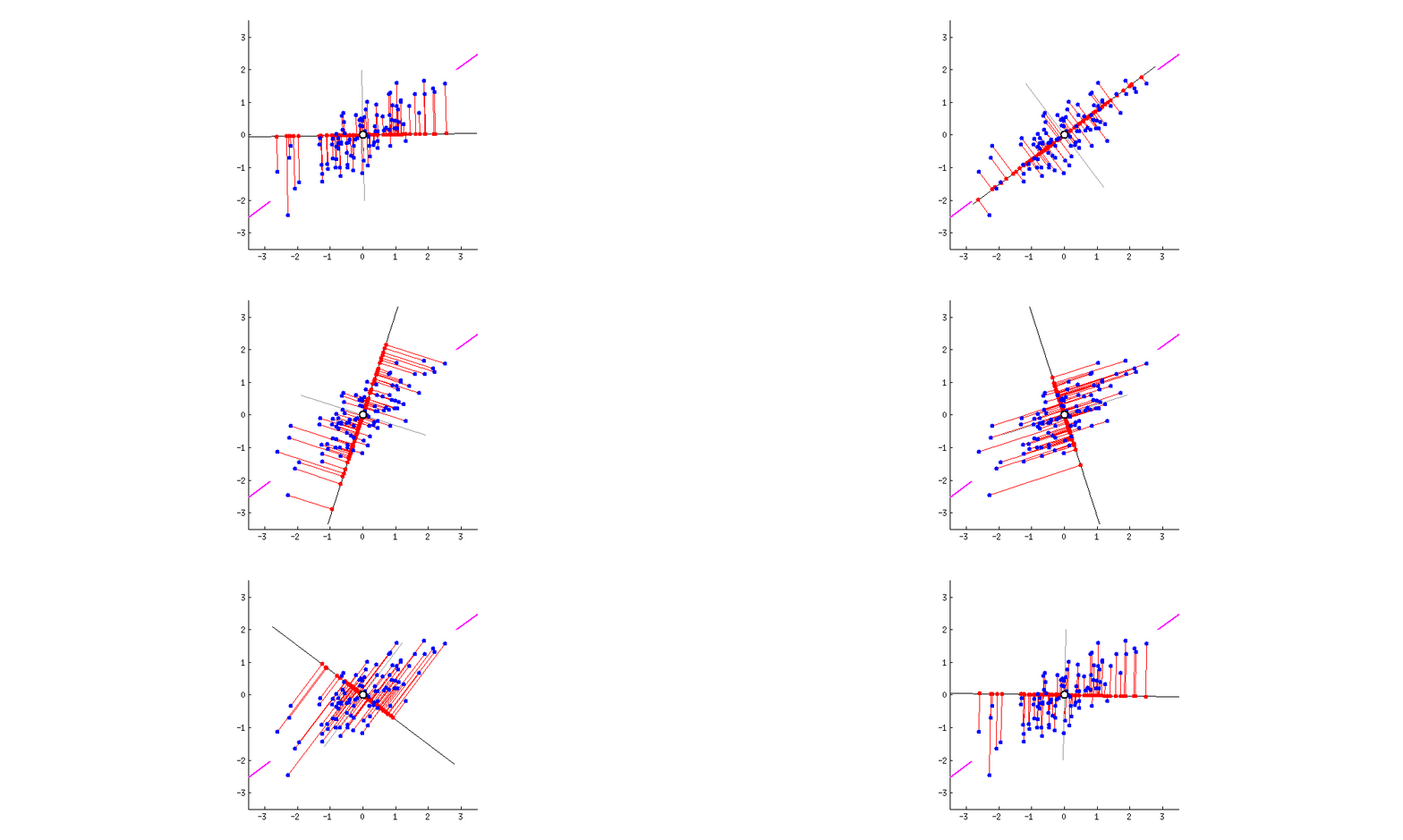
用 PCA 進行資料遮罩
不做降維的 PCA
$$
- 只是將資料集的原始空間做旋轉。
- 因此距離會被保留。
- 有利於預測任務與演算法。
用 PCA 進行資料遮罩
- 若未附說明就公開這些結果值,演算法仍可用它們訓練並做出精準預測。
- 對手將無法解讀這些被遮罩的值。
用 PCA 進行資料遮罩
# Explore the dataset
heart_df.head()
    age    sex    cp    trestbps    chol    fbs    restecg    thalach    exang    oldpeak    slope   ca   thal   target
0    63    1      3     145         233     1      0          150        0        2.3        0       0    1      1
1    37    1      2     130         250     0      1          187        0        3.5        0       0    2      1
2    41    0      1     130         204     0      0          172        0        1.4        2       0    2      1
3    56    1      1     120         236     0      1          178        0        0.8        2       0    2      1
4    57    0      0     120         354     0      1          163        1        0.6        2       0    2      1
用 PCA 與 Scikit-learn 進行資料遮罩
# Obtain the data without the target column x_data = df.drop(['target'], axis = 1)# Target column as array of values y = df.target.values
用 PCA 與 Scikit-learn 進行資料遮罩
# Import PCA from Scikit-learn from sklearn.decomposition import PCA# Initialize PCA with number of components to be the same as the number of columns pca = PCA(n_components=len(x_data.columns))# Apply PCA to the data x_data_pca = pca.fit_transform(x_data)
用 PCA 與 Scikit-learn 進行資料遮罩
# See the data
x_data_pca
array([[-1.22673448e+01,  2.87383781e+00,  1.49698788e+01, ...,
         7.31102828e-01, -2.90393586e-01,  5.12575925e-01],
       [ 2.69013712e+00, -3.98713736e+01,  8.77882303e-01, ...,
         4.04206943e-01, -4.25920179e-01, -1.48124511e-01],
       [-4.29502141e+01, -2.36368199e+01,  1.75944589e+00, ...,
        -9.15397287e-01,  2.17828257e-01,  7.97593843e-02],
       ...,
用 PCA 與 Scikit-learn 進行資料遮罩
# Create a DataFrame from the resulting PCA transformed data df_x_data_pca = pd.DataFrame(x_data_pca)# Inspect the shape of the dataset df_x_data_pca.shape
(1213, 13)
PCA 遮罩後的資料效用
- 用邏輯斯回歸做分類,並比較原始與轉換後資料的準確率是否下降。
$$
- 邏輯斯回歸是分類演算法,用於根據多個自變數預測二元結果。
PCA 遮罩後的資料效用
用邏輯斯回歸做分類,檢查準確率是否下降。
# Split the resulting dataset into training and test data x_train, x_test, y_train, y_test = train_test_split(x_data_pca, y, test_size=0.2)# Create the model lr = LogisticRegression(max_iter=200)# Fit train the model lr.fit(x_train,y_train)# Run the model and perform predictions to obtain accuracy score acc = lr.score(x_test, y_test) * 100 print("Test Accuracy is ", acc)
Test Accuracy is 85.24590163934425
PCA 遮罩前的資料效用
用原始資料搭配邏輯斯回歸做分類,觀察分數。
# Split the resulting dataset into training and test data
x_train, x_test, y_train, y_test = train_test_split(x_data.to_numpy(),y,test_size = 0.2)

# Create the model
lr = LogisticRegression(max_iter=200)

# Fit train the model
lr.fit(x_train,y_train)

# Run the model and perform predictions to obtain accuracy score
acc = lr.score(x_test,y_test) * 100
print("Test Accuracy is ", acc)
Test Accuracy is 85.24590163934425
一起來練習吧!
Data Privacy and Anonymization in Python

