weight_model <- "model{
    # Likelihood model for Y[i]


    # Prior models for a, b, s


}"
定義迴歸模型
weight_model <- "model{
    # Likelihood model for Y[i]
    for(i in 1:length(Y)) {


    }

    # Prior models for a, b, s


}"
對於 $i$ 從 1 到 507,有 $Y_i \sim N(m_i, s^2)$
定義迴歸模型
weight_model <- "model{
    # Likelihood model for Y[i]
    for(i in 1:length(Y)) {
      Y[i] ~ dnorm(m[i], s^(-2))

    }

    # Prior models for a, b, s


}"
對於 $i$ 從 1 到 507,有 $Y_i \sim N(m_i, s^2)$
定義迴歸模型
weight_model <- "model{
    # Likelihood model for Y[i]
    for(i in 1:length(Y)) {
      Y[i] ~ dnorm(m[i], s^(-2))
      m[i] <- a + b * X[i]
    }

    # Prior models for a, b, s


}"
對於 $i$ 從 1 到 507,有 $Y_i \sim N(m_i, s^2)$
$m_i = a + b X_i$
「注意」:使用 <-,不要用 ~
定義迴歸模型
weight_model <- "model{
    # Likelihood model for Y[i]
    for(i in 1:length(Y)) {
      Y[i] ~ dnorm(m[i], s^(-2))
      m[i] <- a + b * X[i]
    }

    # Prior models for a, b, s
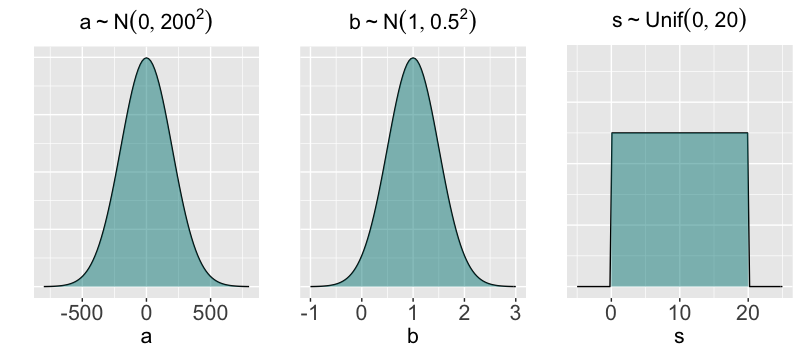
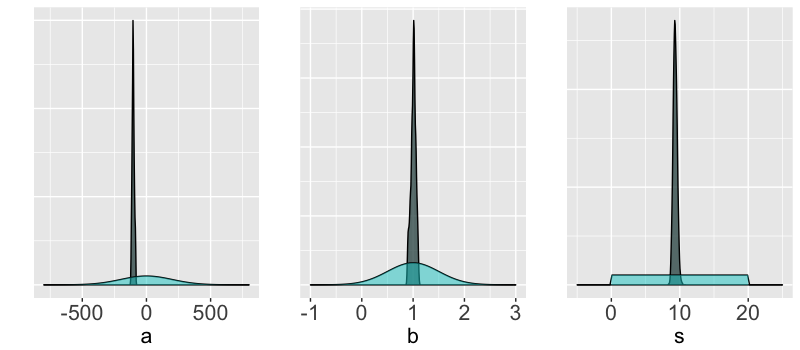
    a ~ dnorm(0, 200^(-2))
    b ~ dnorm(1, 0.5^(-2))
    s ~ dunif(0, 20)

}"